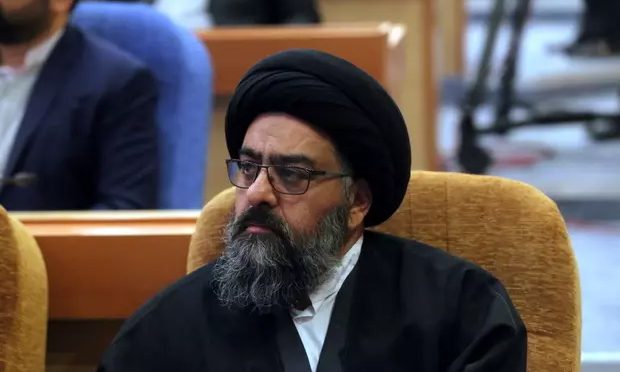
Ayatollah Seyyed Mojtaba Noormofidi

Ayatollah Sayyid Mujtaba noormofidi in an Exclusive Interview with Contemporary Jurisprudence:

Principle of media jurisprudence/12

One of the needs of nascent jurisprudences, for the better resolution of their issues, is the establishment of jurisprudential principles specific to these domains. Jurisprudential principles, whether one accepts them or not, help to bring discipline and systematization to the domains of Fiqh. In the Fiqh of Media, owing to its nascent nature, not many jurisprudential principles have been presented. However, Ayatollah Sayyid Mojtaba noormofidi believes that the issues of Fiqh of Media today are completely different from those of the past and therefore require new jurisprudential principles. According to this professor of advanced kharij Fiqh and Usul at the Qom Seminary, some matters that were once considered incidental to media have now become intrinsic to it. The President of the Research Institute for Contemporary Jurisprudence, in this exclusive interview, analyzes contemporary Fiqh and its jurisprudential principles.

Hujjat al-Islam wa al-Muslimin Ali Nahavandi States in a Note:

Principle of media jurisprudence/11

It can perhaps be said that among the researchers and professors of Fiqh of Media, Hujjat al-Islam wa al-Muslimin Ali Nahavandi has exerted the most effort and diligence. The authorship of more than ten books and several articles, years of teaching advanced kharij lessons on the Fiqh of Media alongside numerous lectures at universities, ten years as the director of IRIB for Khorasan Province, and several years as the director of the Islamic Research Center for Media have made him one of the most important experts in the Fiqh of Media. In this note, which is derived from his lecture in the twelfth session of the training course on Fiqh of Media, Communications, and Cyberspace at Baqir al-Olum University, he analyzes the methodological differences between the Fiqh of Media and other jurisprudential domains. He considers the most important imperative for the Fiqh of Media, relative to traditional jurisprudences, to be the necessity of shifting from a subject-centric to a system-centric approach. The full text of this note, which he has provided to Contemporary Jurisprudence, follows:

Hujjat al-Islam wa al-Muslimin Mohammad Ashayeri Monfared in an Exclusive Interview with Contemporary Jurisprudence:

Principle of media jurisprudence/10

Methodology in contemporary jurisprudence has only been a focus of attention for a few years, and it is mentioned to some extent in the writings and lessons on the subject. Regarding nascent jurisprudential fields, especially the Fiqh of Media, the question has always been whether each of these jurisprudential domains has its own specific method for solving issues, or if contemporary jurisprudence, or the science of Fiqh as a whole, employs a single method for problem-solving. Hujjat al-Islam wa al-Muslimin Mohammad Ashayeri Monfared extends the problem of methodology to all contemporary jurisprudences, though he considers it more severe in the Fiqh of Media. According to this professor and author from the Qom Seminary, to solve the issues of Fiqh of Media, we are compelled to use interdisciplinary studies; otherwise, without such studies, we will not have the ability to efficiently solve the problems of the Fiqh of Media. The detailed account of the exclusive and insightful interview of the faculty member of Al-Mustafa International University with Contemporary Jurisprudence follows:

Mohammad Pourmand

Principle of media jurisprudence/5

Media Jurisprudence and Media Communication: A New Arena in the Field of Humanities and Jurisprudential Studies Ali Darabi, Studies in the Transformation of Humanities, Fall 2022, Issue 11, 26 pages (pp. 116–141). Explanation of the Jurisprudential Ruling on Responding and …

Hujjat al-Islam Mohammad Reza Mahmoudi, in an exclusive note, examined:

Principle of media jurisprudence/9

Hujjat al-Islam Mohammad Reza Mahmoudi is a young researcher at the Islamic Seminary who, in addition to jurisprudence, has studied law and media at the university level. In this exclusive note, he outlines the characteristics of Islamic media for its presence in the international arena. He believes that attention to five key features of Islamic media not only fulfills the satisfaction of the Lawgiver but also garners the favor of international audiences. The full text of this exclusive note follows:

Hujjat al-Islam Mohammad Qotbi, in an exclusive interview with Contemporary Jurisprudence:

Principle of media jurisprudence/7

Note The name of Hujjat al-Islam Mohammad Qotbi is intertwined with innovation. For years, he has initiated projects whose primary characteristic is their novelty. The former head of the Islamic Propagation Office in Isfahan once addressed the organization of playhouses; …

Dr. Mehdi Meqdadi Davoudi, in an exclusive note, outlined:

Principle of media jurisprudence/6

Although media jurisprudence has gained attention as one of the contemporary jurisprudential fields in recent years, with several advanced courses and numerous writings dedicated to it, it has rarely been discussed from a methodological and foundational perspective. Dr. Abbas Meqdadi Davoudi, a researcher of media jurisprudence, in this exclusive note, elaborates on the differences between traditional and modern approaches to media jurisprudence and outlines the requirements of each.

Hujjat al-Islam Mohammad Mahdi Rafipour Tehrani, in an exclusive interview with Contemporary Jurisprudence, stated:

Principle of media jurisprudence/4

Media jurisprudence, compared to other emerging jurisprudential fields, is among those for which significant research and educational steps have been taken. The existence of several advanced courses on media jurisprudence, alongside dozens of books and articles on its various topics, heralds the formation of a new chapter titled “Media Jurisprudence” among contemporary jurisprudential chapters. One of the instructors of these advanced courses is Hujjat al-Islam Mohammad Mahdi Rafipour Tehrani. Born in Tehran, he moved to Qom in 2001 after completing his preliminary studies and benefited from the advanced courses of scholars such as Ayatollahs Tabrizi, Vahid Khorasani, Haeri, and Shobeiri Zanjani. For years, he has been engaged in teaching various courses on jurisprudence, exegesis, principles, and philosophy, and for several years, he has been teaching advanced courses on media jurisprudence at the Tehran Seminary. His four-volume collection, Jurisprudential Explorations, represents part of his jurisprudential efforts. In his conversation with Contemporary Jurisprudence, he elaborated on the foundations of media jurisprudence. According to him, with the current principles of jurisprudence, which focus solely on articulating obligations and excuses, speaking of the efficiency of jurisprudence is meaningless. The full text of Contemporary Jurisprudence’s exclusive interview with this professor of advanced media jurisprudence courses is as follows:

Editorial / Mostafa Dorri

Titles of sanctity in the jurisprudence of arts/29

Art and artistic activities can perhaps be described as the most challenging section or topic within the discipline of jurisprudence. For a long time, the conflict between artists and jurists has been well-known, and numerous stories, poems, and writings have been composed about it. Resolving this challenge has one practical solution and one theoretical solution. The practical solution involves dialogue and creating normal and professional platforms for interaction between jurists and artists, such as joint academic sessions, conferences on the jurisprudence of art, collaboration in producing an artistic work like a film, series, or theater performance, and similar initiatives.

Head of the Department of Jurisprudence and Legal Foundations at Razavi University of Islamic Sciences, in an Exclusive Interview with Contemporary Fiqh

Titles of sanctity in the jurisprudence of arts/28

Hujjat al-Islam Seyed Mehdi Ahmadi-Nik is a long-time graduate of the Mashhad Seminary. In 1999, after receiving his Level 4 degree from this seminary, he pursued his academic studies in Quranic Sciences and Hadith at Razavi University, ultimately earning his Ph.D. in Quranic Sciences and Hadith from this university in 2010. As a faculty member of Razavi University of Islamic Sciences, over the years, in addition to Quranic Sciences and Hadith, he has taught and conducted various research in jurisprudence and legal principles. We spoke with him about the ruling on falsehood in artistic works. Falsehood is widely used in arts such as literature and the scriptwriting of performing arts, where artists create numerous fictional characters and events to enhance the impact of their work, whether in poetry or storytelling. The question is whether these artistic creations fall under the category of falsehood, or whether the very act of creating an artistic work serves as an implicit contextual indication of the “compositional” nature of these cases, thereby negating the notion of falsehood in these arts. According to Ahmadi-Nik, it is highly unlikely that the falsehood prohibited in religious evidence refers to such cases, especially since many of these arts are employed to establish and promote moral and religious values. The full text of the exclusive interview of Contemporary Fiqh with the Head of the Department of Jurisprudence and Legal Foundations at Razavi University of Islamic Sciences is presented below: