Discussion on the Sexual Education of Children from a Jurisprudential Perspective at the Research Institute for Contemporary Jurisprudential Studies

221st Session Aimed at Clarifying the Theoretical and Practical Dimensions of Sexual Education Based on Islamic Jurisprudence

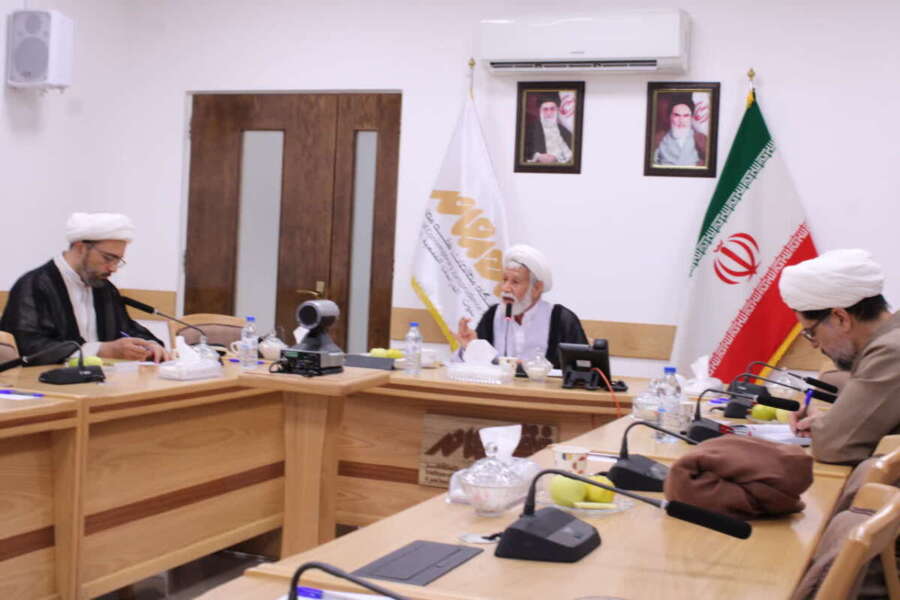
The Department of Social Jurisprudence, Ethics, and Education at the Research Institute for Contemporary Jurisprudential Studies explored a novel and sensitive topic in Islamic education titled “Sexual Education of Children from a Jurisprudential Perspective.”
🔹In this session, scholars in Islamic jurisprudence and educational sciences defined sexual education as a structured set of actions aimed at familiarizing educators and children with religious norms and fostering internal motivation to adhere to these norms. They emphasized that this should be addressed at three jurisprudential levels: extracting an educational system from religious sources, addressing religious legal issues, and incorporating educational approaches into jurisprudential reasoning.
🔹The session also highlighted the importance of understanding gender identity, emotional relationships, and criteria for marital life, the necessity of establishing a cohesive research network, and the development of soft social technologies in this field, while critiquing existing shortcomings.
🏷This session marks the beginning of expanding discussions on sexual education grounded in Islamic jurisprudence, offering a localized and effective alternative to Western models.
Access the full text and audio of this scholarly session:🔻

In an exclusive interview with Contemporary Jurisprudence, Dr. Seyed Sadeq Haqiqat stated:

Analysis of Contemporary Jurisprudence Based on a Minimalist Approach to Fiqh/4

The Theory of Hemrooy is a theory proposed by Dr. Seyed Sadeq Haqiqat for reconciling political jurisprudence and political thought. This theory, which was initially proposed only for reconciling these two disciplines in political science, was later expanded and suggested for reconciling tradition and modernity, as well as other topics.
🔹But one must ask: What is the relationship between this theory and the minimalist and maximalist approaches to religion? Does the Theory of Hemrooy lean toward one of these two approaches, or does it stand in the middle here as well?
🏷The proponent of this theory regards Hemrooy as having a clear boundary with minimalist jurisprudence and maximalist jurisprudence. In his view, this theory even differs from some theories that have been proposed in the middle between minimalist jurisprudence and maximalist jurisprudence.
The full text of Contemporary Jurisprudence’s exclusive interview with the professor at the Research Institute of Imam Khomeini and the Islamic Revolution and a prominent researcher in political thought follows:🔻

In an exclusive interview with Contemporary Jurisprudence, Hujjat al-Islam wal-Muslimeen Mohammad Reza Mahmoudi stated:

Jurisprudence of Governance in Cyberspace/15

Although the concept of cyberspace is clear to many and its jurisprudential issues have been the subject of scholarly discussion for years, does this imply the existence of a distinct jurisprudential chapter called “Jurisprudence of Cyberspace”? In other words, does the Jurisprudence of Cyberspace encompass enough issues to constitute a standalone jurisprudential chapter? Hujjat al-Islam wal-Muslimeen Mohammad Reza Mahmoudi, a faculty member at the Qom Mahallati College and a researcher in the jurisprudence of media and cyberspace, raises a more fundamental issue. He considers the term “cyberspace” itself to be incorrect and, consequently, rejects anything derived from it, such as the “Jurisprudence of Cyberspace.” However, beyond the issue of terminology, he addresses various topics under the umbrella of the Jurisprudence of Cyberspace, which, in his view, does not constitute an independent jurisprudential chapter. The full text of this exclusive interview follows:

In an exclusive interview with Contemporary Jurisprudence, Dr. Mohammad Mehdi Karimi-Nia stated:

Jurisprudential Research on Stem Cells/4

Hujjat al-Islam Dr. Mohammad Mehdi Karimi-Nia, Assistant Professor at the University of Quranic Sciences and Knowledge and a member of the Scientific Council of the “Health and Medical Jurisprudence” Group at the Research Institute for Contemporary Jurisprudential Studies, holds a Level Four (Ph.D.) degree in Islamic Jurisprudence and Principles from the Qom Seminary, as well as a Ph.D. in “Quran and Sciences” with a specialization in “Quran and Law” from Al-Mustafa International University. He has authored numerous works and conducted extensive research in the field of medical jurisprudence. His most notable publications in this area include the books Sex Reassignment from the Perspective of Jurisprudence and Law and Sex Reassignment with an Emphasis on Imam Khomeini’s Perspective. He has published approximately three hundred articles and twenty books. One of his areas of interest in medical jurisprudence is the jurisprudential examination of stem cells. In a detailed discussion, he elaborated on the applications of stem cells. The full text of Contemporary Jurisprudence’s exclusive interview with the member of the Scientific Council of the Health and Medical Jurisprudence Group at the Research Institute for Contemporary Jurisprudential Studies follows: