Emphasis on Demonstrating the Practical Efficacy of the Seal of Religions in Addressing Emerging Issues
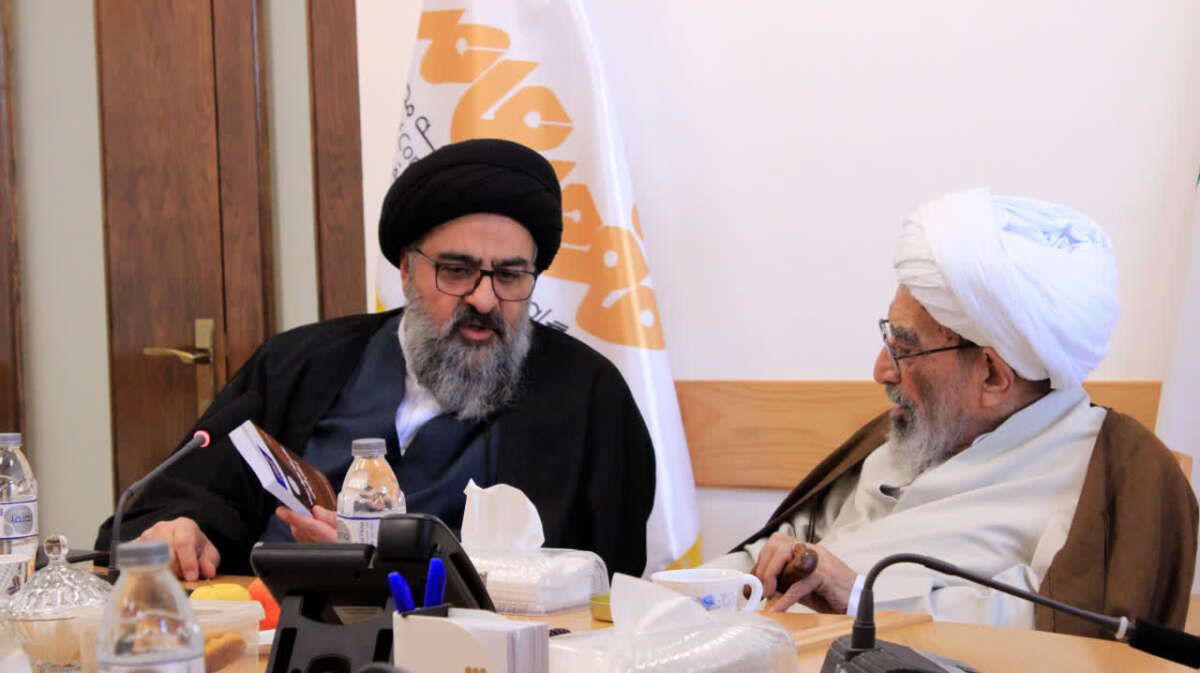
At the outset of the meeting, Hujjat al-Islām wal-Muslimīn Mostafa Dari, Deputy Director of the Institute, extended a warm welcome and delivered a report on the center’s organizational structure and activities. Referring to the work of its specialized research groups, he observed: Specialized units such as Jurisprudence of Environment and Natural Resources, Medical and Health Jurisprudence, Jurisprudence of Culture, Art and Media, Economic Jurisprudence, Jurisprudence of Politics and International Relations, among others, have approved numerous research projects and authored a considerable number of books—some already published and others forthcoming.
He highlighted the holding of nearly 300 scientific sessions—conducted independently or in partnership with other institutions—as a key achievement, adding that conferences such as “Jurisprudence of Art” and “Jurisprudence of City and Urbanization” have taken place, with several additional symposia currently under planning.
The Deputy Director, speaking of the International Group’s efforts, reported the establishment of academic links with universities and seminaries across the Arab world and the West. He noted: Numerous scientific sessions have been convened in Persian, Arabic, and English. Moreover, a dedicated website has been launched, cataloguing active centers in contemporary jurisprudence worldwide, together with their fields of focus, faculty members, contact details, and scholarly profiles.
During the visit, the “Contemporary Jurisprudence Lessons Portal”—a comprehensive gateway—was introduced. This database is devoted to organizing, archiving, and disseminating advanced (khārij) lessons in contemporary jurisprudence from the 1970s onward.
Hujjat al-Islām Mousavi, administrator of the system, described its scope: Over 100 advanced contemporary jurisprudence courses delivered by professors from the Qom, Mashhad, and Najaf seminaries—including current lectures and those of departed scholars—have been collected, documented, digitized, and made accessible to researchers via the platform.
Continuing the visit, Ayatollah Seyyed Mojtaba Nourmofidi, President of the Institute for Contemporary Jurisprudence Studies, elucidated the concept of contemporary fiqh: Contemporary jurisprudence extends the traditional category of “newly arisen issues” (masā’il mustaḥdathah), but with an expanded scope that also encompasses the fresh re-examination of longstanding questions through modern lenses.
The advanced-level instructor at the Qom Seminary, noting the incorporation into khārij lectures of subjects such as cryptocurrencies, energy jurisprudence, art jurisprudence, and other novel domains, announced the initial drafting of 28 jurisprudential chapters. He explained: Within these 28 chapters, the systematic classification of issues in each field is being finalized and published; several chapters are already at an advanced stage of compilation.
The Institute’s President characterized this endeavor as a crucial advance in the “systematization of jurisprudential issues,” stating: Prior to issuing rulings on specific questions, the granular topics within each domain—such as environmental jurisprudence—must first be meticulously identified and extracted from Qur’anic verses, hadith, and jurisprudential principles. Dozens of sub-issues fall under each broad heading; some have been studied while others still await in-depth investigation.
He further referred to the publication of scholarly compilations encompassing interviews, analytical notes, and research files, citing examples such as “Foundations and Presuppositions of Environmental Jurisprudence” among completed projects, and underscored: All such research remains firmly anchored in Qur’anic verses, prophetic narrations, general principles, and established jurisprudential rules. No novel sources are invented; rather, fresh interpretations and contemporary applications are developed.
In concluding the meeting, Ayatollah Ashrafi Shahroudi expressed his pleasure at the Institute’s endeavors and described them as a practical step toward proving the timeless vitality of the Islamic faith.
He remarked: “When we assert that Islam is the seal of religions and remains responsive until the Day of Judgment, this must transcend mere assertion. We must demonstrate that this religion offers solutions even for today’s intricate challenges.”
Citing the profound social and legal transformations worldwide, Ayatollah Ashrafi Shahroudi stressed: Contemporary society cannot be governed using outdated frameworks without renewed reading and dynamic ijtihad. Shia jurisprudence must, with awareness of global developments and legal systems, acquire the capacity for comparative analysis and superior articulation.
He insisted: Claims alone are insufficient. While familiarizing ourselves with the laws and rights systems of other nations, we must scholarly present the latent capacities of Islamic jurisprudence so that it may speak authoritatively on the global stage.
The Mashhad Seminary scholar also commended Ayatollah Seyyed Mojtaba Nourmofidi’s innovative approach and commitment to emerging topics, viewing the Institute’s work as a source of optimism and reassurance for the seminaries at large, and offered prayers for the sustained progress of this scholarly endeavor.
Throughout the meeting, strong emphasis was placed on the need to produce contemporary jurisprudential works in multiple languages and distribute them to libraries and academic institutions worldwide—an initiative capable of showcasing the adaptive, efficacious character of Islamic jurisprudence and reinforcing the dignity of Islam internationally.
Ayatollah Ashrafi Shahroudi’s visit to the Institute for Contemporary Jurisprudence Studies may be regarded as indicative of the concern among marāji‘ and leading seminary scholars for the systematic development of contemporary jurisprudence and its methodical, scholarly engagement with the complexities of the modern world. If sustained and reinforced, this trajectory promises to open fresh horizons for jurisprudential inquiry.