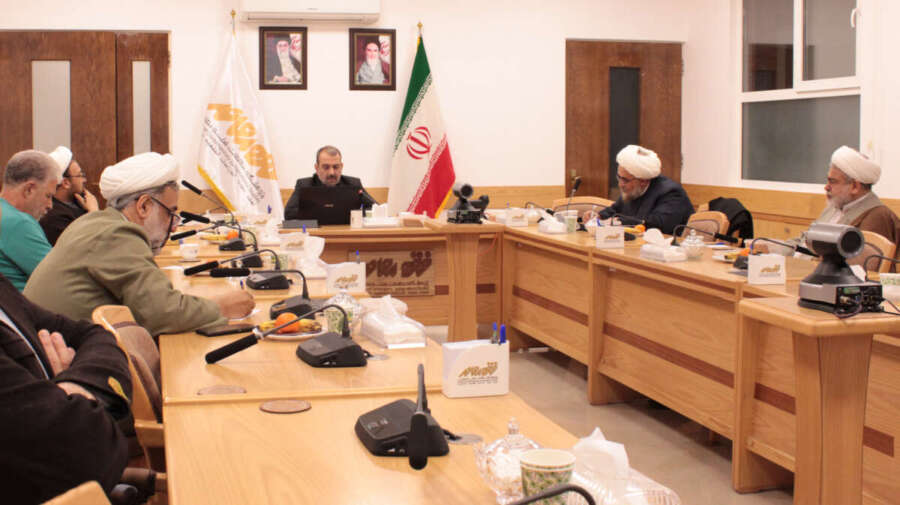
According to the information portal of the Contemporary Fiqh Research Institute, the 250th scientific session of the institute—organized by the “Fiqh of Politics and International Relations” group and featuring a presentation by Dr. Abdulwahhab Farati with a critique by Dr. Seyyed Sadeq Haqiqat—was held on Sunday, December 14, 2025, in Qom, with the attendance of professors and researchers.
At the outset of the session, the scientific secretary, Hujjat al-Islam wal-Muslimeen Dr. Mohsen Mohajerniya, welcomed the participants and commemorated Research Week. Referring to Dr. Farati’s numerous publications and extensive research background in the contextual analysis of Najaf’s political thought, he introduced him as one of the foremost authorities in studies on the Najaf seminary.
In the course of the session, Dr. Farati presented findings from his latest research, underscoring the imperative of contextual comprehension of the political thought of Najaf jurists. Critiquing the dominant text-centered methodology in the Qom seminary, he stated: “Iranian authors have typically interpreted texts without grasping their context, leading to transhistorical and decontextualized narratives of fiqh chapters.”
As a member of the Fiqh of Politics and International Relations group, he explained that analyzing the ideas of Najaf jurists without regard to the historical, social, and linguistic contexts of text production has yielded misguided conclusions. He illustrated this error with prevalent interpretations of Ayatollah Khoei’s views, adding: “The assertion that Ayatollah Khoei advocated political leadership by jurists arises from interpreting texts detached from their historical frameworks and contexts.”
In his opinion, many of Ayatollah Khoei’s stances during the Sha’baniyyah Intifada were emergency responses to Iraq’s critical circumstances and cannot be regarded as his enduring political theory.
A substantial portion of Dr. Farati’s presentation was dedicated to elucidating the historical role of Akhund Khorasani in establishing the prevailing norm within the Najaf seminary. Noting the persistence of this hegemony from the Constitutional period to the present, he affirmed: “All Najaf jurists operate within a corridor that Akhund Khorasani established as the customary norm in this city.”
Farati further expounded his scholarly findings by explaining how this norm has steered Najaf jurists toward embracing the model of a “council-based state” or “consociational democracy,” thereby alienating them from the theory of the shar’i state or the political guardianship of jurists. He noted that this shift stems from Najaf’s historical engagement with sectarianism in Iraq.
The presenter identified the emergence of the “national state” concept as the most significant outcome of Najaf’s intellectual evolution. He clarified that this state is neither a shar’i state grounded in jurists’ guardianship nor a secular one, but rather one in which:
Political authority is delegated to the people;
Shar’i constants are upheld;
The supreme oversight of marja’iyyah is maintained.
Dr. Farati stressed that this paradigm responds to Iraq’s enduring sectarian crisis, with many Najaf jurists viewing it as the sole viable path forward.
In conclusion, Dr. Farati referenced outcomes from his dialogues with contemporary Najaf jurists, asserting that they have attained a more nuanced grasp of the modern state. He observed that many such jurists, in terms of social identity, primarily identify as “Iraqi,” signifying practical acceptance of the nation-state within their thought.
According to him, this intellectual shift has significantly contributed to the emergence of a civil state in Iraq, demonstrating that the Najaf seminary—despite its absence from direct power—has developed a profound insight into state transformations in the contemporary era.