
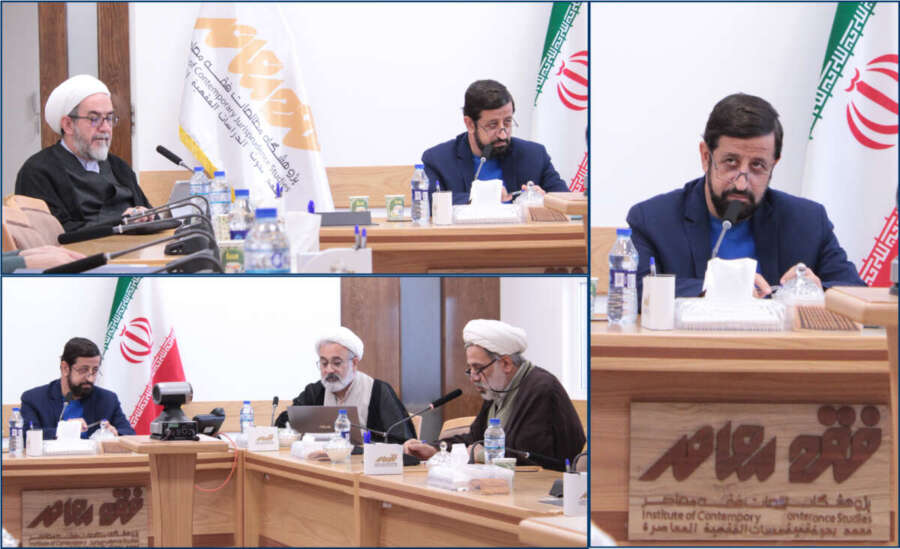
According to the Research Institute for Contemporary Jurisprudence Studies, the sixty-eighth session of the Methodology Sundays series, centered on “The Methodology of Legislative Governance Based on Islamic Principles,” was held yesterday afternoon, Tuesday, December 15, 2024, at the research institute, in the presence of a group of professors and researchers in jurisprudence and law.
In this session, Dr. Hosseinali Bay, faculty member of the Research Institute for Islamic Culture and Thought, presented a discussion titled “The Foundations and Requirements of Sound Legislation Based on Sharia Principles,” and two scientific critics, Hujjat al-Islam wal-Muslimeen Dr. Gholamreza Pivyandi and Hujjat al-Islam wal-Muslimeen Dr. Ali Mohammadi Jurkuyeh’i, presented their complementary and critical views.
Dr. Bay, at the beginning of his remarks, emphasized that, contrary to some views, jurisprudence alone is not sufficient for governing society, and the existence of law is an unavoidable necessity in Islamic governance. Referring to the widespread divergence of fatwas on various topics, such as blood money for injuries, as well as emerging complexities in areas such as cybercrimes, banking, stock exchange, and commercial companies, he explained that without coherent legislation, efficient societal governance is impossible. He added that the high volume of judicial cases and the need for specialized and mujtahid judges indicate that reliance solely on jurisprudence is impractical, and law must define executable frameworks.
The second axis of his speech was devoted to the question of which part of jurisprudential rulings is capable of being transformed into law. He outlined the two existing views: the maximalist view, which holds that all jurisprudential rulings—even highly personal ones—are legislable, and the minimalist view, which limits law to the realm of public order, social security, and the regulation of interpersonal relations. Dr. Bay, citing the conduct of the Infallibles and historical examples, considered the second view more realistic.
Subsequently, he addressed the important challenge of diverging fatwas and asked: “Which fatwa should the legislator adopt as the basis?” He examined options such as the renowned fatwa of the ancients, the renowned fatwa of contemporaries, the fatwa of the Leadership, the opinion of the jurists of the Guardian Council, the precautionary fatwa, and the more executable fatwa, ultimately deeming the more executable and operational fatwa the most suitable basis for legislation. Citing examples from the performance of the Guardian Council, he demonstrated that this council, in practice, does not follow a uniform approach and sometimes decides based on the renowned fatwa, sometimes on the fatwa of the Leadership, and sometimes on executive expediency.
In the critique section, Dr. Pivyandi emphasized the necessity of precisely defining the concepts of jurisprudence, law, and their interrelationship, stating that the language of jurisprudence fundamentally differs from the language of law, and transforming jurisprudence into law requires linguistic and expert precision. He also stressed the role of specialists in fields such as psychology, sociology, and behavioral sciences in the legislative process.
Dr. Mohammadi Jurkuyeh’i, referring to the absence of a unified criminal and legislative policy in the country, identified this as the root of many inconsistencies. He emphasized that punishments have extensive effects on families and society and must be designed with a macro and pathological perspective.
The session concluded with a summary of the discussions and an emphasis on the necessity of developing a coherent model for Islamic legislation.
It is noteworthy that this session was originally scheduled for November 29, 2024, but due to some unforeseen issues, it was held with a two-week delay on December 15, 2024.