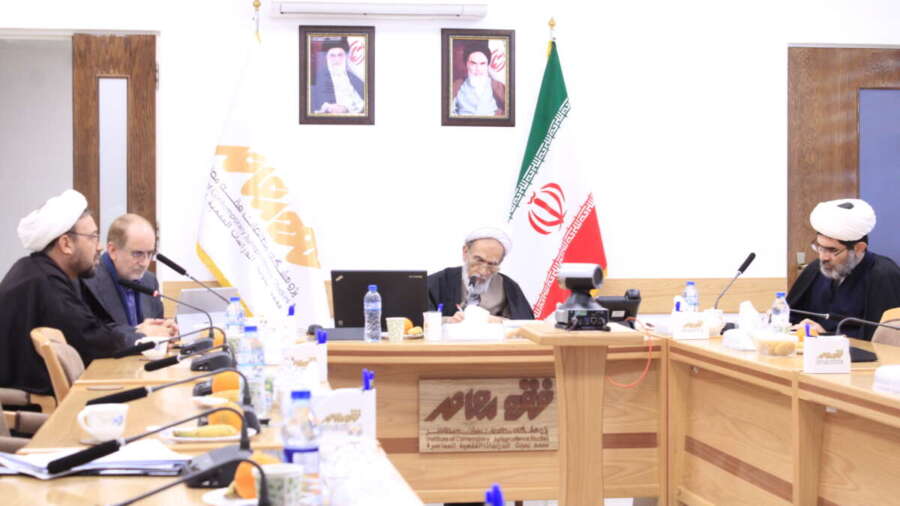
According to the Site of the Research Institute for Contemporary Jurisprudence Studies, the Complex of Research Institutes for Islamic Humanities and the Hawzah and University Research Institute, in cooperation with the Islamic Sciences Research Institutes of the Hawzah and University Research Institute, on the occasion of the 1500th birth anniversary of the Holy Prophet, Muhammad Mustafa (PBUH), held the scientific session of the conference “The School and Conduct of the Great Prophet (PBUH), Human-Building and Society-Processing Islamic Humanities” and a scientific-promotional chair titled “The Right to Self-Determination in the Quran” on Wednesday, January 6, 2026, at the Research Institute for Contemporary Jurisprudence Studies.
At the beginning of this session, Hujjat al-Islam wal-Muslimeen Dr. Ali Sharifi, the scientific secretary of the session and the Secretary of the Political Jurisprudence Research Group, stated: “The right to self-determination as a fundamental right is discussed both in the international arena, meaning the freedom of nations from the imposition of political and cultural systems, and in the domestic arena as a citizenship right and the basis of democracy. The main issue is whether Islamic jurisprudence and Sharia also recognize this right like international law or not.”
He noted: “In the domestic arena, the discussion of the right to self-determination has a close connection with the concept of democracy, and the Quranic examination of this subject is considered one of the most important theoretical discussions of Islamic human rights.”
Continuing, Hujjat al-Islam wal-Muslimeen Mustafa Daneshpajouh, a professor at the Hawzah and University Research Institute and the main presenter of the chair, while congratulating the feasts of the month of Rajab and appreciating the organizers, said: “The subject of the right to self-determination in the Quran, inasmuch as it pertains to transmitted (Naqli) and revelatory roots, must be examined by precise reference to the import of the verses. In this research, we analyzed verses related to freedom, free will, and human guidance from three aspects of corresponding indication (Dilalah Mutabiqi), implicative indication (Tazammoni), and necessitative indication (Iltizami) so that the relationship between ontological (Takvini) and legislative (Tashri’i) freedom becomes clear.”
He emphasized that although there are diverse interpretations of the verses in this field, he stated: “There is no rival view in this field; rather, the difference lies in literature and the manner of expression.”
Daneshpajouh continued: “In the foundations of individual rights, the right to self-determination is considered the most fundamental human right, because deprivation of it prevents the realization of other human rights. This right has both an external dimension which pertains to the independence of nations, and an internal dimension which relates to democracy.”
Explaining the concept of right, he added: “Right in legal literature is a correlative concept (Zat al-Izafah), and negligence of this feature sometimes entails incorrect results. Ontological freedom, more than being equal to right, is the bedrock for the emergence of right, and Quranic verses also mostly emphasize this very ontological freedom of humans in choosing faith or disbelief.”
The professor of the Seminary and University, in another part of his speech, referring to Quranic verses, said: “Regarding the core of the discussion, it is observed that verses in this field are divided into several categories:
The first category are verses that indicate human freedom in choice and free will regarding the matter of religion and guidance.
The second category are verses that some, in their presumption, believe imply freedom of choice in absolute destiny; such as the verse ‘Indeed, Allah will not change the condition of a people until they change what is in themselves.’
But the third category are verses that address the prohibition of imposing religion and belief, from which prohibition, freedom and right are inferred.”
He added: “This third category also has three important sub-groups:
-
Verses that convey the lack of coercion and compulsion in religion.
-
Verses that seemingly limit prophets merely to warning and giving good tidings, such as: ‘Say, I am only a warner.’
-
Verses that speak of the non-responsibility of prophets regarding people not believing.”
Dr. Daneshpajouh added that there are other classifications to complete the discussion: “Verses that imply human dignity and vicegerency, verses referring to human equality, verses indicating the human right to perfection citing the verse ‘And I did not create the jinn and mankind except to worship Me,’ and also verses that have addressed peaceful coexistence, consultation, and enjoining the good and forbidding the evil.”
In the final part of the presentation, he stated: “What is certain is that the import of these cited verses is the ontological freedom of humans to choose any type of destiny. However, regarding legislative freedom and legislative right, none of these verses have corresponding or implicative indication on the issue, nor is a clear necessitative indication (Ddalat-e Iltizami-ye Bayyin) obtained from them.”
He added: “If there is an indication, it is a non-clear necessitative indication and requires argumentation. The maximum that can be said is the prohibition of imposing faith on another, not proving the legislative right to choose any type of belief and any type of destiny.”
Completing the discussion, Daneshpajouh said: “Choosing a belief or destiny prepares the ground for the duty to choose a positive belief and a positive destiny. Quranic promises and threats are so that humans do not go towards deviation and seek guidance.”
He also added: “From the prohibition of imposing belief, which is a matter of the heart, freedom in physical actions (A’mal-e Javarahi) is not obtained, and some verses consider humans free in choosing a dignified life while simultaneously warning them against a humiliated life.”
In the first critique section, Dr. Mustafa Fazaeli, a professor of International Law at the University of Qom, said: “The subject of the right to self-determination is among the most fundamental legal and human discussions, and addressing it Quranically is considered a special privilege for this chair. It is fitting that the results of this research be published in the form of an article and an English version of it be prepared for international scientific circles.”
He added: “It would have been better if the definition of right in Islamic jurisprudence and its difference from international law were explained more precisely; because in traditional jurisprudence, right is interpreted as a person’s dominion over what is under his authority.”
Fazaeli continued: “The relationship between ‘being right’ (Haqq Budan) and ‘having a right’ (Haqq Dashtan) is among the important discussions of the philosophy of human rights, and the complete separation of these two is not compatible with the universality of human rights.”
He clarified: “Being free does not mean being legitimate; free will simultaneously brings responsibility, and freedom and right do not have intrinsic value unless in the light of the Divine purpose.”
Continuing, Hujjat al-Islam wal-Muslimeen Dr. Mohammad Shojaian, the second critic, said: “The presentation focused more on the individual dimensions of the right to self-determination, whereas this issue is mainly raised in social and political contexts, and its political management has special importance.”
At the end of the session, the scientific secretary of the meeting, appreciating the presenters and critics, expressed hope that the results of this session would be developed in the form of a scientific article and pave the way for interdisciplinary dialogues between jurisprudence, law, and political science.
The scientific session “The Right to Self-Determination in the Quran” demonstrated that freedom in the view of the Quran is simultaneously the basis of duty and an indicator of human dignity, and interdisciplinary research in this field possesses special importance.