
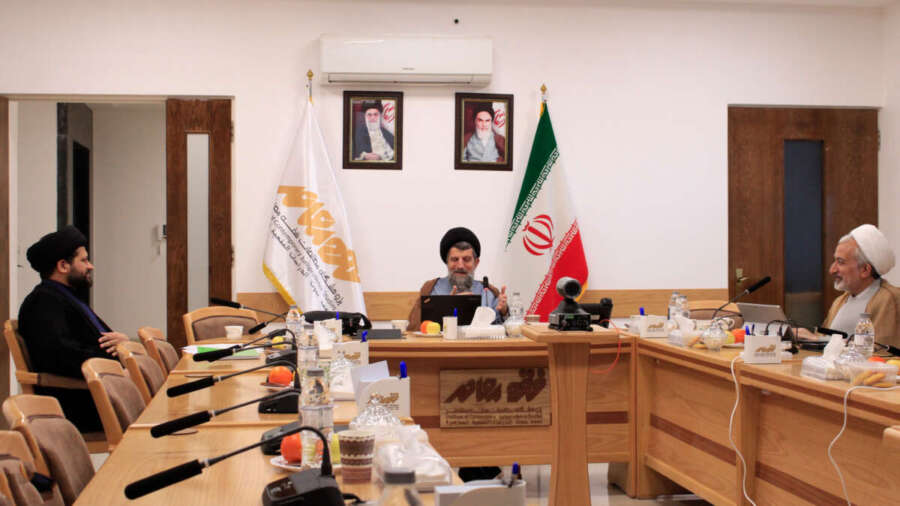
The 275th scientific session of the Research Institute for Contemporary Jurisprudence, entitled “Examining the Degree of Hardship (Ḥaraj) Relative to Preserving Fetal Life,” was convened in Qom with the attendance of a number of professors and researchers specializing in medical jurisprudence. Organized by the Institute’s Medical Jurisprudence and Health Group, the session centered on one of the most challenging contemporary jurisprudential-medical topics.
According to the Research Institute for Contemporary Jurisprudence, the session was held on Monday, 20 Bahman 1404 SH (February 9, 2026). It featured a scholarly presentation by Hujjat al-Islam wal-Muslimeen Sayyid Muhammad Ali Faqihi, professor of advanced (sutūḥ ‘āliya) and khārij levels at the ḥawza, and a scholarly critique by Hujjat al-Islam wal-Muslimeen Sayyid Sadiq Razavi, a specialized graduate of the Medical Jurisprudence Group at the Jurisprudential Center of the Pure Imams (peace be upon them). The scientific secretariat was conducted by Hujjat al-Islam wal-Muslimeen Dr. Muhammad Mahdi Karimi-Nia, a member of the Scientific Council of the Medical Jurisprudence and Health Group.
Opening the session, the scientific secretary highlighted the topic’s significance and defined the meeting’s objective as “a precise analysis of the position of the shar‘ī ruling of hardship (ḥaraj) in matters such as abortion, along with the identification of its precise boundaries and criteria.” He underscored the particular sensitivity of the issue from jurisprudential, medical, ethical, and social standpoints.
Distinction Between Fatwā-Oriented and Scholarly Discussion
Hujjat al-Islam wal-Muslimeen Faqihi began by posing the question: Is it permissible to rule in favor of abortion on the basis of hardship (ḥaraj)? He drew attention to ambiguity surrounding the precise meaning of “ḥaraj” and stressed: “It is essential to clearly define the scope of this term to prevent its unrestricted and undisciplined expansion.”
Limitation of the Discussion to the Pre-Enlivenment Stage
The professor emphasized that the discussion of hardship applies solely to the period prior to the breathing of the soul into the fetus. Per the relevant narrations, soul enlivenment (wulūj al-rūḥ) occurs at four months; jurisprudential differences pertain only to the preceding stage.
Definition of Hardship and Requirement of Near-Certain Proof
He described “ḥaraj” as an extreme hardship exceeding ordinary difficulty, insisting that its occurrence must be verified to a degree approaching certainty (qarīb ilā al-yaqīn). High probability alone is insufficient to justify abortion permission; hence, regulations stipulate confirmation by three specialist physicians and judicial authority.
Non-Applicability of the “No Hardship” Rule to Prohibited Matters
The core of the presenter’s reasoning concerned the scope of the “lā ḥaraj” rule. Invoking the verse “And He has not placed upon you in the religion any hardship” (Qur’an 22:78), he explained: “There is no dispute regarding obligations in this context; however, in prohibitions, the Qur’an permits only necessity (iḍṭirār). Necessity is distinct from hardship; thus, abortion—whose prohibition is firmly established—is not lifted by hardship.”
He further deemed reliance on anticipated future hardships invalid, stating: “Is the fetus to be aborted on account of a hardship projected to occur six or seven years hence? Such reasoning is logically untenable. Hardship must be actual (bi-l-fi‘l); forecasting potential future difficulties does not warrant lifting an existing prohibition.”
Methodological Critique by the Session Critic
In his critique, Hujjat al-Islam wal-Muslimeen Razavi, while upholding the prohibition of abortion, challenged the requirement of “certainty of hardship” by invoking the principle of the authoritativeness of conjecture (ḥujjiyyat al-ẓann) in the subjects (mawḍū‘āt) of rulings. He remarked: “If conjecture is deemed authoritative in the subjects of rulings in other contexts, then conjectural hardship may likewise be accepted as authoritative in the subject of the no-hardship rule.”
He regarded the applicability of the no-hardship rule to prohibitions as a foundational (mabnā’ī) matter and, based on the unqualified wording of the verse, argued: “The evidence contains no restriction limiting hardship to the actual or excluding the future-oriented. The generality of the ratio legis in the verse encompasses future hardship as well. Should permission be established for the parents, the physician’s action would no longer fall under ‘assisting in sin.’”
Concluding the session, the scientific secretary expressed appreciation to both the presenter and the critic. He observed that the principal divergences centered on foundational principles—namely, the authoritativeness of conjecture in subjects, the extension of the no-hardship rule to prohibitions, and the analysis of whether the rule functions by lifting (raf‘) or averting (daf‘) hardship.
The session illustrated that the interplay between the no-hardship rule and the preservation of fetal life continues to rank among the most intricate and debated issues in contemporary medical jurisprudence. It demands meticulous attention to foundational principles, careful differentiation between hardship (ḥaraj), harm (ḍarar), and necessity (iḍṭirār), and concurrent consideration of jurisprudential, medical, and ethical dimensions.