
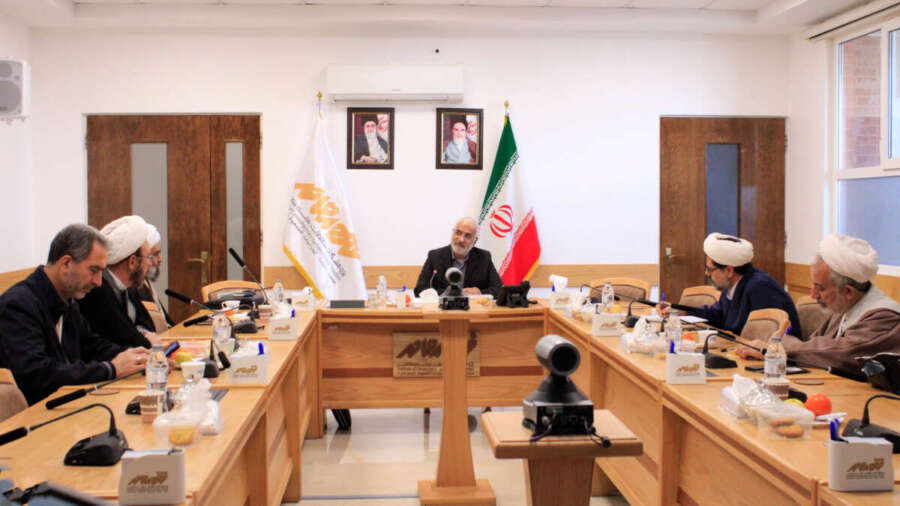
According to the Contemporary Jurisprudence Studies Research Institute, the 276th scientific session of this institute was held with a focus on the fiqh-legal challenges of invoking the “Rule of Nafy al-Ḥaraj” in abortion. The session sought to examine the relationship of this rule with prohibited acts, the criterion for the realization of ḥaraj, its scope in the 1400 law [i.e., the 2021–2022 solar year law, corresponding to the Law on Protection of the Family and Youth of Population], as well as the ambiguity in determining “entry of the soul” as the main knots in legislation in this field.
In this session, Dr. Esma’il Baba’i raised questions about the inclusion of “nafy al-ḥaraj” with respect to prohibited acts, current or future ḥaraj, and determining the bearer of ḥaraj, speaking of practical ambiguities in the implementation of the law. Ayatollah Qa’ini, emphasizing the personal nature of ḥaraj and the concessional (imtenānī) character of the rule, critiqued expansive generalizations in this regard. These discussions showed that the transition from a fiqh proposition to statutory text is still accompanied by theoretical and practical challenges.
Dr. Baba’i, referring to years of collaboration experience with the Legal Medicine Organization, addressed the multitude of unanswered questions in this domain.
According to him, the first challenge is whether the rule of nafy al-ḥaraj fundamentally includes prohibited acts or not, since abortion in itself is considered among prohibited matters.
Dr. Baba’i then pointed to the distinction between “current ḥaraj” and “future ḥaraj” and stated: “In many cases, the fetus at the time of requesting permission lacks an actual ḥarajī status, and the predictions concern future difficulties. It must be considered whether the ḥaraj that is expected to occur in the future and has not yet occurred can serve as permission for abortion or not?”
Among other axes of discussion was determining the bearer of ḥaraj: whether the criterion is the mother’s ḥaraj, the father’s, the child’s, those around them, or even society? Dr. Baba’i, referring to the law’s explicit mention of “the mother’s ḥaraj,” said this choice itself is controversial, since in some cases the main burden of problems falls on the father or the extended family.
Also, in cases such as pregnancy resulting from rape or the possibility of “honor killings,” the question arose regarding the validity of “psychological ḥaraj” and social threats as permission for abortion. Dr. Baba’i warned that disregard for these realities could have dangerous practical consequences.
Among other challenges raised were the potential conflict of the rule of “nafy al-ḥaraj” with the principle of “iḥtiyāṭ in blood(s)” [precaution in matters involving life] and also the ambiguity in determining the precise criterion for “entry of the soul.”
Dr. Baba’i, referring to differing fiqh views in this regard and also the limitations of medicine in determining the exact time of the soul’s infusion, stated: “The physician fundamentally does not deal professionally with the concept of the soul as a metaphysical matter. He can determine the time of heart formation or the beginning of brain activity based on scientific indicators, but regarding when the soul is infused, he has no scientific tool or criterion for giving an opinion.”
In his view, when the fatwa permitting abortion in ḥaraj cases enters the arena of legislation, a general fiqh proposition is no longer sufficient, and detailed, complex, and sometimes unpredictable questions must be answered—from the role of the mother’s or physician’s fault in creating the ḥarajī situation to the criterion of personal or general ḥaraj and the possibility of compelling those around to cooperate in diagnostic tests.
In the continuation of the session, Ayatollah Qa’ini, focusing on the “conceptualization of ḥaraj” and the scope of the rule of nafy al-ḥaraj, critiqued and examined Dr. Esma’il Baba’i’s presentation.
He distinguished between “‘usr” and “ḥaraj,” stressing the necessity of lexical and customary precision in understanding these concepts, and said ḥaraj means “severe constriction and unbearable pressure,” not every type of hardship. He stated, with the explanation that ḥaraj refers to a hardship beyond ordinary difficulties: “Ḥaraj means severe constriction; a task whose pressure is to such a degree that custom says ‘my soul has reached my lips.’ Not every hardship is ḥaraj.”
He divided “endurance” (ṭāqat) into rational and customary, explaining that the locus of discussion in the rule of nafy al-ḥaraj is customary endurance, not rational impossibility; because obligation to the impossible is not issued by the Legislator in the first place.
One of the most important axes of critique was determining the scope of the rule of nafy al-ḥaraj. Ayatollah Qa’ini, citing the generality (iṭlāq) of the evidences, considered this rule to encompass both domains of “performing an obligation” and “omitting a prohibition,” and emphasized: “The generality of the ḥaraj evidences covers both performing an obligation and omitting a prohibition; wherever omitting a prohibition or performing an obligation causes ḥaraj, the ruling is lifted.”
Applying this basis to the issue of abortion, he added that in this discussion, the issue is the lifting of the obligation to preserve the fetus in the assumption of realized ḥaraj, and if retaining the fetus causes ḥaraj for the mother, the rule can lift that obligation.
The session’s critic also addressed the question of whether nafy al-ḥaraj merely creates a “permission” (rukhṣa) or leads to “obligation.” Referring to the concessional nature of the rule, he said: “Concessional rules do not lead to obligation; the language of nafy al-ḥaraj is the language of lifting, not establishing. If someone wishes to endure the ḥaraj, he has not committed a sin.”
Continuing, Ayatollah Qa’ini, emphasizing that in fiqh discussions the criterion is “personal ḥaraj” and not general, warned that making general and statistical perceptions the criterion is incompatible with the basis of the rule. He also considered future ḥaraj included in the generality of the evidences and stated: “It is not necessary for ḥaraj to be actual; if there is rational fear of ḥaraj occurring in the future, the ḥaraj evidences encompass it.”
In the final part of the session, the attendees summarized the discussions and responded to some of the raised challenges. One of the professors, referring to the concept of “indications of entry of the soul,” emphasized that in the law, “voluntary movement” is not mentioned as the criterion; rather, signs for detecting entry of the soul are raised, and four-monthliness in fiqh is mostly recognized as an indication and temporal ceiling, not an exact and instantaneous point.
Discussion also took place regarding the scope of the rule of “nafy al-ḥaraj,” and some speakers stressed the necessity of a rational and limited understanding of the generality of this rule, reminding that not every customary difficulty can be considered permission to commit prohibitions, especially in a matter such as abortion that is linked to the issue of precaution in matters of life.
Emphasis was also placed on the need to distinguish between different levels of life and precision in detecting the “human soul,” and it was suggested that to clarify existing ambiguities, other specialized sessions be held with the presence of jurists and physicians. The session concluded with appreciation to the attendees.