
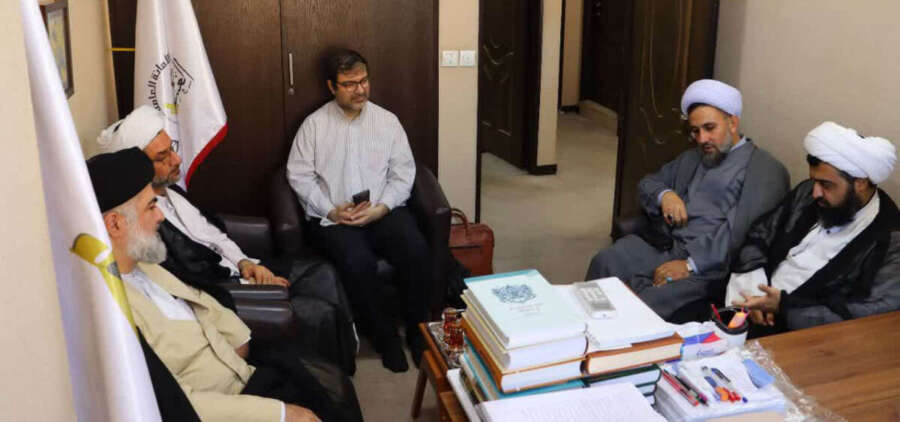
Hujjat al-Islam wal-Muslimeen Dorri, during a visit to the Allamah Hilli Center affiliated with the Holy Shrine of Imam Hussain (Qom Branch), met and held talks with Hujjat al-Islam wal-Muslimeen Mousavi, Director of the Allamah Hilli Center in Qom, and Hujjat al-Islam wal-Muslimeen Fazel Firoozi (Head of Content Production).
According to the news portal of the Research Institute of Contemporary Jurisprudence, Hujjat al-Islam wal-Muslimeen Dorri, Vice President of this research institute, accompanied by Hujjat al-Islam wal-Muslimeen Pourmand, Head of Communications, and Dr. Moballeghi, Director of International Relations, emphasized during this meeting the capacities of the Research Institute of Contemporary Jurisprudence in rereading jurisprudential heritage and extracting emerging issues from the core authentic sources of Shia jurisprudence, noting: “This research institute, adopting a modern approach and responding to contemporary needs, seeks to address emerging jurisprudential issues while laying the groundwork for broad academic cooperation with research centers and seminary scientific institutions.”
Pointing to the prominent status of the jurists of Hillah in the history of Shia jurisprudence, he stated: “The works of the scholars of this city, including Allamah Hilli, possess immense capacities for indexing, problem-orientation, and linking with Contemporary Jurisprudence, and this scientific heritage can be utilized to produce encyclopedias, specialized seminars, and comparative research.”
Hujjat al-Islam wal-Muslimeen Dorri, stating that problem-orientation and mapping the “problem network” constitute the main axes of work at the Research Institute of Contemporary Jurisprudence, added: “In diverse fields such as the Jurisprudence of Art, Jurisprudence of Media, Jurisprudence of Upbringing, Jurisprudence of Ethics, Jurisprudence of the Environment, Jurisprudence of Energy, and Jurisprudence of Judiciary, efforts are made to identify issues precisely and assess their status so that research moves away from scattered and isolated forms and turns into a coherent roadmap for knowledge production.”
Allamah Hilli Center Affiliated with the Holy Shrine of Imam Hussain (Qom Branch)
During this meeting, Hujjat al-Islam wal-Muslimeen Mousavi, while welcoming the delegation, emphasized the necessity of a serious return to jurisprudential heritage (turath) and manuscripts of prominent scholars, specifying: “One of the serious vulnerabilities of research institutes is that in some cases, a heritage-oriented perspective is lacking in their work, and operations rely merely on what was previously available; whereas one must once again consult manuscripts and original sources to extract fresh information from their depths.”
Pointing to an example from the works of the late Aqa Bozorg Tehrani, he noted: “Certain historical and jurisprudential data have been reviewed less frequently after him, and it is now necessary to re-consult manuscripts to complete and update this information.” According to him, this approach can lead to a more precise reconstruction of the scientific history of jurists and jurisprudential heritage.
The Director of the Allamah Hilli Center in Qom, regarding the volume of works that can be enumerated and examined along this path, stated: “If works such as Qawa’id and Irshad along with their supplements are taken into consideration, the scope of work will be immense, although further assessments regarding the exact number of volumes and progress rate still need to be conducted.” He simultaneously announced the existence of an active branch in Najaf pursuing a portion of these activities.
This meeting, while highlighting the scientific status of the city of Hillah and its jurists, emphasized the importance of rereading jurisprudential heritage, utilizing the potential of ancient sources and manuscripts, and expanding academic cooperation between the Research Institute of Contemporary Jurisprudence and the research center of the Iraqi Holy Shrine—cooperation that can lead to the production of new works, the revival of ancient sources, and more precise responses to contemporary jurisprudential issues.