Specialized Session on Family Jurisprudence at the Research Institute for Contemporary Jurisprudence Studies

Jurisprudential and Legal Analysis of Family Economic Challenges and the Obligations of the Islamic Ruler in Supporting Couples

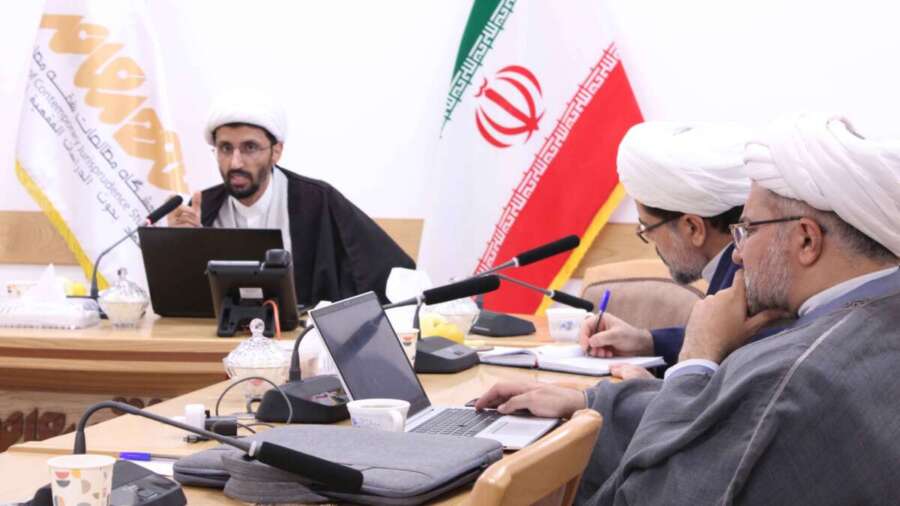
The 224th session of the Family and Women’s Jurisprudence Group at the Research Institute for Contemporary Jurisprudence Studies, titled “The Role of the Islamic Government Regarding Couples Unable to Pay Maintenance,” was held.
🔹 Hujjat al-Islam wal-Muslimeen Dr. Mahdi Saadatinasab, the main presenter, focused on the inability to pay maintenance “without willful fault” and examined the jurisprudential and legal role of the Islamic government.
🔍 Citing Quranic verses, narrations, and jurisprudential sources, he emphasized that the Islamic government is not only obligated to refrain from enforcing judicial divorce but must also undertake the role of providing economic support for the incapacitated couple.
🏷 The distinction between “intrinsic inability” and “relative inability with respect to others” was a key point of this scholarly session, which can influence the ruling on divorce or financial support.
🔸 A member of the Specialized Family and Women’s Jurisprudence Group at the Research Center of the Institute of Advanced Jurisprudence and Islamic Sciences, referencing Martyr Sadr’s book Our Economy, outlined two models of government intervention in individuals’ economic issues: social solidarity and direct intervention. He emphasized the obligation of economic support for the incapacitated couple.
For the full text of the news and the complete audio of this session, see below: 🔻
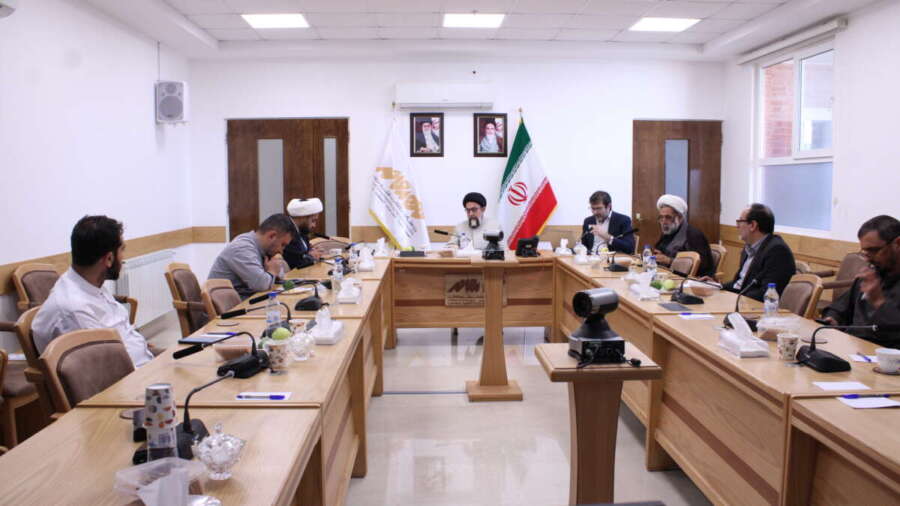
Dr. Seyed Hossein Hosseini: The issue must be analyzed more precisely, deeply, and with attention to the relationship between teachings and cultural context

In the fifty-ninth session of the “Method on Sundays” series, under the theme “Methodological Requirements for Transforming Islamic Knowledge into Public Culture,” Dr. Seyed Hossein Hosseini, a faculty member of the Research Institute for Humanities and Cultural Studies, emphasized the importance of precisely framing the issue, stating: “Until the issue is properly analyzed, any response may lead to error.”
🔹 He described Islamic knowledge as a multifaceted and diverse concept encompassing jurisprudence (fiqh), theology (kalam), ethics, and more, stressing that not all religious teachings can be transformed into public culture. Dr. Hosseini noted that the methodology in this field requires an interdisciplinary, philosophical, and cultural research perspective, stating: “The transformation process must be accompanied by intellectual persuasion, scientific critique, and attention to social structures.”
🏷 He also warned against the dangers of oversimplification, superficiality, and the lack of theorization in this area, emphasizing the need to design precise and actionable solutions within the context of contemporary civilization.
For the full text of the news and the audio of this scholarly session, see below: 🔻

In an exclusive interview with Contemporary Jurisprudence, Hujjat al-Islam wal-Muslimeen Qadirali Shams stated:

Principles of the Jurisprudence of Education/4

Hujjat al-Islam wal-Muslimeen Qadirali Shams, born in 1965 in Isfahan and a graduate of the Qom Islamic Seminary, began teaching advanced lessons (Dars-e Kharij) on the Jurisprudence of Ethics in 2016, the results of which were published in three volumes titled Fiqh al-Akhlaq. Subsequently, he turned his attention to the Jurisprudence of Education and began discussing its topics in his advanced lessons.
🔹His simultaneous teaching of the Jurisprudence of Education and the Jurisprudence of Ethics makes him one of the most qualified individuals to discuss the Jurisprudence of Education and its differences from related fields such as the Jurisprudence of Ethics. He considers the relationship between the Jurisprudence of Ethics and the Jurisprudence of Education to be one of general and specific correlation from a certain perspective (‘umum wa khusus min wajh). The recipient of the Islamic Republic of Iran’s Book of the Year Award also mentions Fiqh Akbar (Greater Jurisprudence) in this context, explaining its meaning and its relationship to conventional jurisprudence.
The detailed and insightful text of Contemporary Jurisprudence’s exclusive interview with this professor of advanced lessons on the Jurisprudence of Education at the Qom Islamic Seminary is as follows:🔻