
The Jurisprudential Examination of Child Gender Selection in Imami Fiqh at the 260th Scientific Session of the Research Institute for Contemporary Jurisprudence
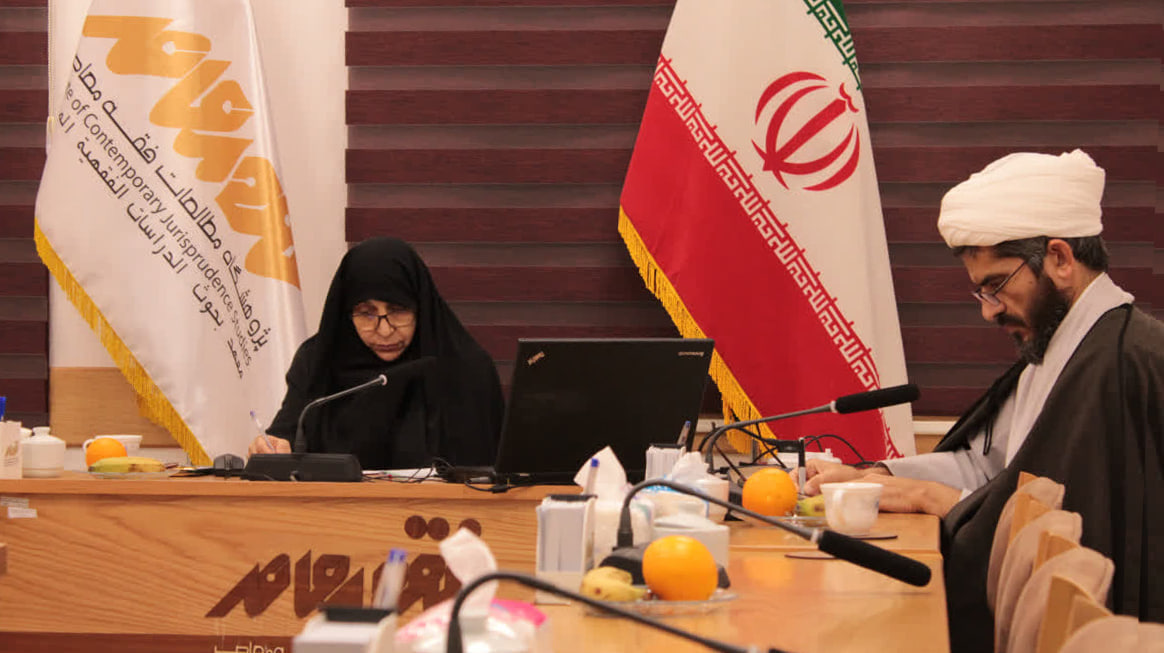
The 260th scientific session of the Research Institute for Contemporary Jurisprudence, focused on “Jurisprudential Examination of Child Gender Selection in Imami Fiqh,” was held on Sunday, December 21, 2025, in Qom. This session was organized by the Women’s and Family Affairs Jurisprudence Group of the Institute and attended by Ms. Maryam Barqei as the presenter, Hujjat al-Islam wal-Muslimeen Dr. Hossein Bostan as the critic, and Hujjat al-Islam wal-Muslimeen Dr. Mehdi Davoudabadi as the session secretary.
Dr. Davoudabadi, at the beginning of the session, while congratulating the advent of the month of Rajab and the birth of Imam al-Baqir (peace be upon him), pointed to the importance of the session’s topic and added: “Determining the gender of a child is one of the emerging issues in family jurisprudence that has arisen with advancements in medicine and genetics, requiring precise jurisprudential examination.”
Then, Ms. Maryam Barqei presented her views and stated: As a member of the Scientific Council of the Women’s and Family Affairs Jurisprudence Group, serving as the presenter, she addressed various jurisprudential and medical dimensions of gender selection and said: “If it is possible to determine gender before pregnancy, the question arises whether it is permissible in itself or only under specific conditions?”
The member of the Scientific Council of the Women’s and Family Affairs Jurisprudence Group, regarding the prevention of certain genetic and hereditary diseases, noted: “Some hereditary diseases manifest only in one specific gender, and gender selection can prevent hardship and difficulty for the family.”
The presenter, regarding the role of jurisprudential principles in this issue, stated: “The principles of la darar and la haraj can apply here; for if prohibiting gender selection causes harm and hardship to the family, the Lawgiver has not enacted such a ruling.”
She, referring to the principle of bara’ah (acquittal) in jurisprudence, added: “The default rule regarding subjects of rulings is permissibility; therefore, if no evidence for prohibition is found, we must rule in favor of permissibility.”
She also warned about social consequences and noted: “The primary concern is gender discrimination in society; if the majority develops a preference for one specific gender, this can lead to serious social and cultural consequences.”
In the continuation of the session, Hujjat al-Islam wal-Muslimeen Dr. Hossein Bostan, in critiquing the presenter’s remarks, while emphasizing the need for caution regarding social consequences, stated: “We should not suffice with individual evidences alone; the social consequences of gender selection can be far-reaching.”
He, referring to the noble verse 49 of Surah ash-Shura (“To Allah belongs the dominion of the heavens and the earth. He creates what He wills. He gives to whom He wills females, and He gives to whom He wills males”), explained: This verse indicates that it is God who grants daughters or sons to whomever He wills and attributes the bestowal of children to divine will; therefore, human intervention in this matter must be accompanied by caution and precise interpretation.
The member of the Scientific Council of the Women’s and Family Affairs Jurisprudence Group at the Research Institute for Contemporary Jurisprudence, emphasizing the need to attend to social consequences, noted: “Although the principles of la darar and la haraj can apply in specific cases, they should not become a pretext for absolute permissibility.”
At the end of the session, Dr. Davoudabadi, referring to the discussions presented and the critiques, stated: “This topic requires further examination from jurisprudential and social perspectives. A distinction must be made between rational motives, such as disease prevention, and purely personal motives.”
The secretary of the Research Department for Social, Cultural, and Health Jurisprudence noted: “The role of governance in managing societal gender ratios is also among the important issues that must be addressed.”
The scientific session of the Research Institute for Contemporary Jurisprudence demonstrated that the issue of child gender selection in Imami fiqh is a multifaceted topic dependent on both religious evidences and jurisprudential principles, as well as social and cultural consequences. In this session, diverse views ranging from absolute permissibility to absolute prohibition, and differentiation based on specific conditions, were raised, with emphasis placed on the necessity of continuing jurisprudential and social research in this field.