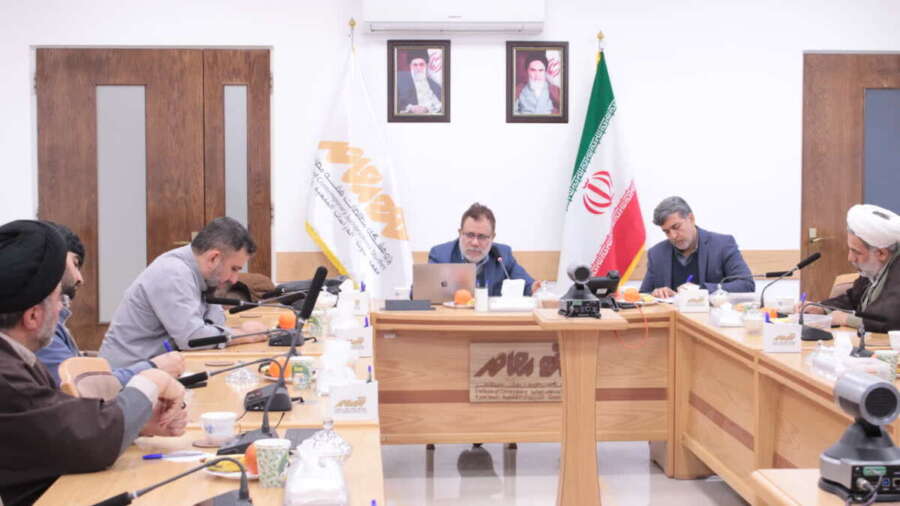
According to the information portal of the Research Institute for Contemporary Jurisprudence Studies, the second session of the series “Methodology of Legislative Governance Based on Islamic Principles” on the topic “Processes and Methods of Identifying Subjects with an Approach to Legislability” was held on Wednesday, December 17, 2025, with the participation of professors and researchers in the field of governance jurisprudence at the Research Institute for Contemporary Jurisprudence Studies. This session, organized within the framework of the autumn series “Methodology Sundays” and in collaboration with the Islamic Research Center of the Parliament and the Desk for Development and Empowerment of Islamic Sciences of the Islamic Propagation Office, addressed one of the most foundational questions in religious governance: which parts of jurisprudence have the potential to be transformed into law, and how should this identification be carried out?
At the beginning of the session, Hujjat al-Islam wal-Muslimeen Mohammad Kazem Haqqani Fazl, Director of the Encyclopedia of Contemporary Jurisprudence and Scientific Secretary of the session, while commemorating Research Week and highlighting the importance of the topic, stated that in systems such as the Islamic Republic, the concern for implementing religion at the level of governance raises significant questions about the relationship between jurisprudence and legislation.
He emphasized: “Whether all of jurisprudence should be transformed into law or only a part of it is a fundamental question. If we legislate all individual, devotional, and family rulings, on what criteria and foundations should this be done?”
In the continuation of the session, Dr. Mahmoud Hekmatnia, professor at the Research Institute of Islamic Culture and Thought, spoke as the main presenter. He began his discussion by elucidating the concept of “legislation” and explained that legislation, in essence, means the official recognition by the authority of a behavioral proposition accompanied by enforcement guarantees.
The professor at the Research Institute of Islamic Culture and Thought added: “When we speak of legislation, we mean making a behavior obligatory and providing enforcement guarantees for it. This obligation differs from moral or personal commitment.”
He distinguished between “commitment” and “obligation,” stating: “We are not speaking of commitment but of obligation; that is, where the authority imposes an obligation to perform or refrain from an act.”
Dr. Hekmatnia, referring to two philosophical approaches in law, said:
Legal positivists hold that the source of obligation is political, and the state determines what should be obligatory.
In natural law, obligation arises from the essence of the rule, and the ruler merely identifies it.
He clarified in this regard: “If the subject is correctly chosen, it becomes law; if poorly chosen, it leads to despotism.”
One of the main axes of the presentation was the distinction between two categories of rules: foundational rules and managerial rules:
- Foundational Rules (Basic Rights and Duties) • Concerned with rights and duties • Requiring philosophical and jurisprudential inference • Conformity with jurisprudence is essential in this domain
Dr. Hekmatnia explained this section by saying:
“Foundational rules are those that attribute rights and duties to the essence of behavior. These must conform to jurisprudence.”
- Managerial Rules (Instrumental Laws for Achieving Objectives) • Concerned with governance objectives • Essentially composite and expert-based • Non-opposition to jurisprudence is sufficient
The professor at the Research Institute of Islamic Culture and Thought added in this regard: “In managerial laws, the primary criterion is objectives. These laws need not conform to jurisprudence; it is sufficient that they do not oppose it.”
To clarify the discussion, he provided examples from the age of puberty, family rights, vows, dowry, and unilateral obligations, explaining that not all religious duties have the potential to be transformed into legal obligations.
Following the presentation, Dr. Mohammad Mehdi Moqaddadi, associate professor at Mofid University, spoke as the scientific critic and expressed his views. While appreciating the structured nature of the discussion, he raised three points of critique.
He emphasized the lack of clarity in the boundary between foundational and managerial rules, adding: “In many social issues, the boundary between foundational and managerial rules is gray, and they cannot be easily separated.”
The associate professor at Mofid University, referring to the variability of foundational rules, stated: “In practice, we have seen that some basic rules have also changed. How does this change align with the provided definition?”
Dr. Moqaddadi, emphasizing the role of jurisprudence in the managerial domain, noted: “The presented distinction may overlook the capacities of jurisprudence in the managerial domain, as jurisprudence also has contributions in many managerial areas.”
The continuation of the session was dedicated to the question-and-answer section with the attendees, where questions were raised, including: the relation of the discussion to the theory of minimal and maximal state, the role of the guardianship of the jurist in the domain of obligation, whether the principle is legislation or non-legislation, and the place of interdisciplinary knowledge in the application of jurisprudence.
The scientific secretary, in concluding the session with a summary of the discussions, emphasized that the topic of “legislability” is one of the most foundational issues in religious governance and requires continued research and specialized sessions.
The session “Methodology of Legislative Governance” was an important step in elucidating the theoretical foundations of Islamic legislation and demonstrated that the path to identifying “legislable subjects” requires ongoing dialogue, complementary research, and collaboration among various related scientific domains.
It is noteworthy that this session, which had previously been scheduled for October 12, 2025, was rescheduled due to operational reasons and held on December 17.