
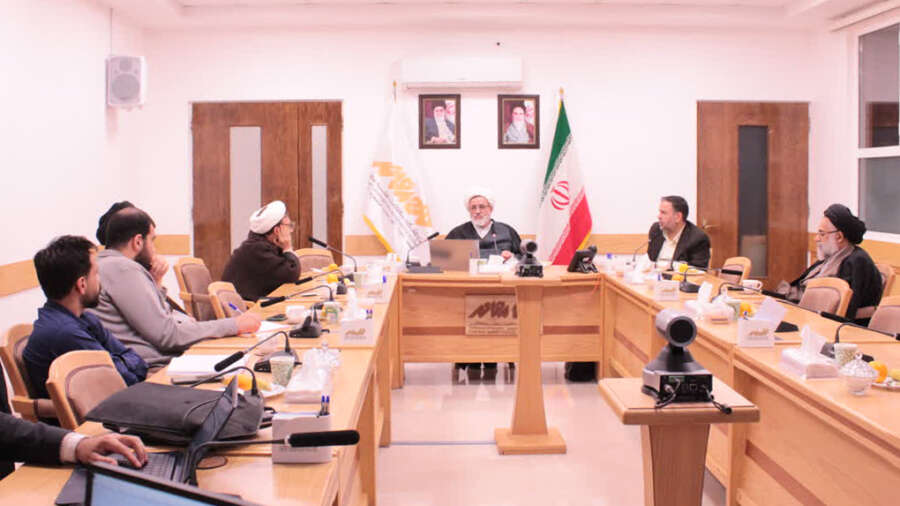
Note: According to the report issued by the information portal of the Research Institute for Contemporary Jurisprudence Studies, during the institute’s 255th session, Dr. Ahmad Hajidehabadi—the academic secretary of the session—reviewed the post-Revolution legislative history and identified Article 92 of the Islamic Penal Code as a pivotal development in recognizing the condition of maturity. Hujjat al-Islam wal-Muslimeen Dr. Saeid Rahaei, stressing that “will must be grounded in awareness,” pointed out that children and the insane lack such will. Referencing scientific findings and international instruments, he emphasized that criminal maturity is a gradual process and that mere physical puberty cannot serve as the basis for full criminal responsibility.
At the outset of the session, the session secretary, Dr. Ahmad Hajidehabadi, highlighting the significance of the topic, observed: “This session marks the second occasion on which the Research Institute for Contemporary Jurisprudence has addressed the critically important subject of maturity in criminal matters.”
As a faculty member of the University of Tehran, he reviewed Iran’s legislative history, noting that, following the Revolution, the age of religious puberty—consistent with the predominant view among jurists—was incorporated into the laws. However, the perennial question has been whether mere religious puberty suffices for the application of hudud and qisas, or whether the condition of maturity must also be verified. Hajidehabadi pointed to Article 92 of the Islamic Penal Code approved in 2013, describing it as a landmark in this regard.
Thereafter, Hujjat al-Islam wal-Muslimeen Dr. Saeid Rahaei—professor of advanced jurisprudence (dars kharij) and associate professor at Mofid University—presented his perspectives. Emphasizing the interplay between jurisprudence, social realities, and international developments, he stated: “The rule must accord with reality. Failure to align with international conventions will create difficulties in international relations.”
The associate professor at Mofid University analyzed the concept of criminal responsibility, elucidating the role of maturity in imputing a crime to an individual, and added: “For the mental element of a crime to materialize, will must be founded on awareness; from a rational viewpoint, neither a child nor an insane person possesses such will.”
Dr. Rahaei, drawing on international documents and empirical cases, elaborated on the intricate aspects of children’s criminal responsibility: “This principle is articulated in the Statute of the International Criminal Court. The challenge with children extends beyond mere inability to comprehend the ruling; at times, they fail to grasp the subject matter entirely. Instances have been observed where adolescents aged 15 or 16 were charged with offenses—such as waging war against God—whose meaning they did not understand. This underscores the gravity of the issue concerning comprehension of the subject.”
He further noted: “Occasionally, a child fails even to recognize the prohibition of an act, having been raised in an environment where improper behaviors have become normalized. Conversely, certain children exhibit intelligence and technical proficiency, yet their intellect has not yet gained mastery over their emotions. Criminal maturity encompasses not only understanding the subject and the ruling but also the capacity to control emotions and actions.”
The professor of advanced jurisprudence and associate professor at Mofid University then cited scientific findings: “Maturity is not abrupt; a child may attain physical puberty today yet still lack the intellectual and psychological capacity for sound decision-making. Medical research indicates that the maturation of gray matter in the brain—particularly in the prefrontal cortex—continues until approximately ages 21 to 24. Accordingly, full criminal responsibility cannot be imposed on children and adolescents at younger ages.”
During the question-and-answer portion, one participant inquired about the narration from Imam Baqir (peace be upon him) and the notion of “mudrik” (one who perceives). He remarked: “Perception in this narration equates to puberty; however, the primary challenge lies in the concept of ‘complete hudud.’ Does this intend the full execution of punishments or the applicability of laws?”
In response, Dr. Rahaei stressed: “In the narrations, God has established reason as the criterion for rulings and punishments. It is untenable to hold that an individual lacking complete reason from a psychological standpoint bears full responsibility and is subject to full punishment.”
In conclusion, Dr. Sharifi and Dr. Ahmadzadeh posed questions regarding the deterrent function of punishments, objective criteria for maturity, and the relationship between puberty and criminal responsibility. Dr. Rahaei replied: “Punishments, beyond their deterrent role, must respect the rights of the child. Puberty serves as a presumption of relative—not absolute—criminal responsibility. Age is not an objective criterion but a legal presumption. The true criterion lies in the individual’s social and customary conduct.”
The academic secretary, in his closing summation, declared: “We hope that the Research Institute for Contemporary Jurisprudence will compile and publish these discussions, as they hold considerable utility. In the forthcoming session, Dr. Rahaei will conclude the treatment of international law, after which we shall proceed to the jurisprudential section to examine the evidences supporting the condition of maturity in criminal responsibility.”