
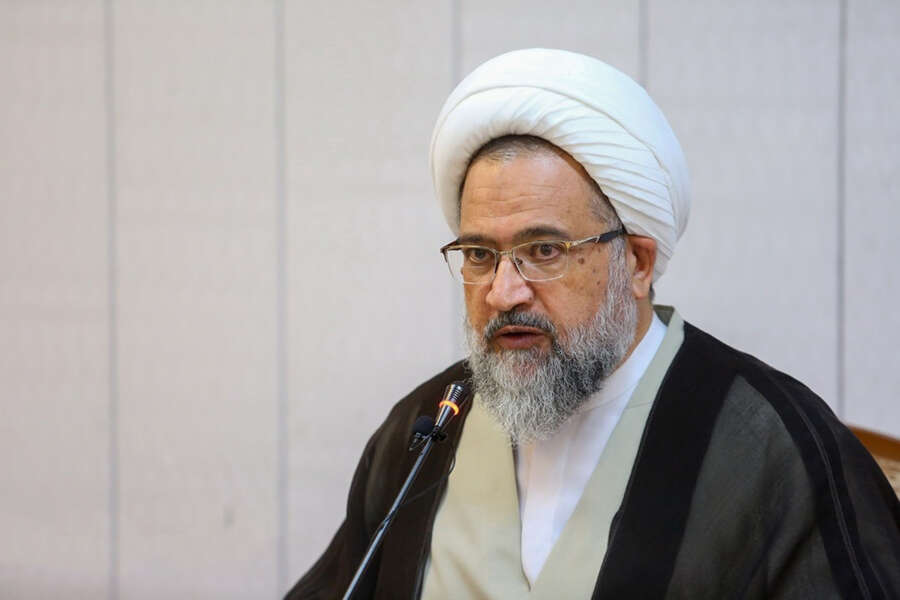
Ayatollah Abulqasim Alidoust, member of the Board of Trustees of the Research Institute for Contemporary Jurisprudence Studies, during the academic session entitled “The Role of Jurisprudence in the Exegesis of the Quran,” held on the evening of Wednesday, December 24, 2014, at the Isra Institute, stated: Before participating in the session, I reflected that it must first be clarified whether we seek to comprehend the role of Quranic exegesis in jurisprudence or the role of jurisprudence in Quranic exegesis. The reason for this ambiguity stems from errors that arise concerning the meaning and scope of “jurisprudence,” inasmuch as jurisprudence is sometimes mistakenly equated with Sharia.
The professor of advanced jurisprudence and principles of jurisprudence at the Qom Seminary, asserting that Sharia is not of human origin, expressed: Sharia is infallible, devoid of error or disagreement, whereas jurisprudence is human and thus susceptible to error and disagreement. Jurisprudence is subject to change and open to discourse, functioning as the discoverer of Sharia—that is, jurisprudence represents humanity’s endeavor to uncover Sharia. At times, the term “jurisprudence” denotes the academic discipline of jurisprudence, which stands as a field of knowledge alongside others; at other times, the same term refers to the process of ijtihad (independent reasoning/inference), which transcends mere knowledge and enters the realm of practice. In this latter sense, the jurist is one who carries out the process of inference, though this process remains inseparable from knowledge. In a third sense, jurisprudence applies neither to the discipline nor to the process but rather to the assemblage of propositions that manifest through the inferential process within the discipline of jurisprudence.
The member of the Society of Seminary Teachers of Qom, emphasizing that he is not pursuing a discussion on the role of the Quran in jurisprudence during this session, added: The role of the Quran in jurisprudence has been unduly neglected, and this significant topic warrants far greater attention than it has hitherto received. We have attended to the Quran, yet not in the manner that is truly befitting. The entirety of the Quran influences the process of inference; should we seek to derive systems, atomic rulings, numerous jurisprudential rules, or major paradigms, recourse to the Quran is indispensable. The rule of hardship (haraj), the rule of justice, and analogous principles are not merely rules in light of the Quran but constitute paradigms of Sharia.
This professor of advanced seminary courses, underscoring this point, stated: The inference of detailed propositional rulings, general rules, paradigms, and even principles of jurisprudence—all are extractable from the Quran. I intend to author a systematic treatment of the role of the Quran in jurisprudence, thereby illuminating the extent to which our eminent scholars have drawn upon the Quran. The late Ayatollah Ma‘rifat regarded the entire Quran as comprising verses pertaining to rulings; in my estimation, enumerating such verses is not the proper approach, as the interpreter’s perspective invariably influences their count.
In expounding the title “The Role of Jurisprudence in the Exegesis of the Quran,” he declared: To clarify this title, one must inquire whether it denotes the role of jurisprudential propositions in Quranic exegesis or the role of the discipline of jurisprudence therein. I prefer to bypass these two interpretations. My present discussion centers on the role of the inferential process in Quranic exegesis—that is, the jurist applies the very inferential operations employed to discern Sharia rulings to the exegesis of the Quran as well. Accordingly, my aim is to elucidate “the role of the inferential process in Quranic exegesis.”
Ayatollah Alidoust further remarked: An inferential approach to exegesis and a jurisprudential lens on interpretation prompt the question: Is inference reserved exclusively for Sharia rulings? I categorically reject this view, for the inference utilized in jurisprudence extends beyond the mere discovery of rulings. Should one seek to uncover a theological or epistemological matter, inference is equally requisite. Ijtihad bears two connotations: one specific, pertaining to religious rulings, and the other general, encompassing religion in its totality. The more proficient an exegete is in inference, the more adept he manifests in Quranic exegesis.
The member of the Board of Trustees of the Research Institute for Contemporary Jurisprudence Studies, noting that the principles of jurisprudence form the logic of inference, stated: It would be an injustice to this science to construe it solely in service of jurisprudence; the principles of jurisprudence are, in truth, the principles of comprehension, and their discussions lend themselves readily to other disciplines. In the anecdote of “the pomegranate thief and the bread thief,” wherein an individual donated stolen goods in charity and justified his act by invoking two Quranic verses, the Imam countered by citing the verse “Allah accepts only from the God-wary.” The Imam thereby instructed us that the Quran must be interpreted within a circular system or a hierarchical system; the principles of jurisprudence serve as the exegete’s universal tool in Quranic interpretation, lest contradiction ensue.
Ayatollah Alidoust, recalling a memory from the 1970s, described the discourses on human creation during that era as exceedingly broad and added: At that time, Darwin’s theory had only recently gained prominence, prompting certain seminary scholars to author works on the subject. When we submit to the Quran, we observe that human creation is articulated in diverse forms—once from “dust” and elsewhere from “altered mud.” Just as, in jurisprudence—for instance, in the discussion of the traveler’s prayer—we conduct inference within systems and macro-systems, the identical methodology must be employed in Quranic exegesis.
The professor of advanced courses at the Qom Seminary asserted: To produce a monumental, technically rigorous, and disciplined exegesis, we must possess robust inferential and argumentative prowess and apply a juristic perspective and orientation to interpretation.
To exemplify the juristic perspective on Quranic verses, he cited verse 119 of Surah al-Baqarah and stated: This verse ranks among the Quran’s firm verses. Herein, the Prophet (PBUH) is presented with an outlook of glad tidings and admonition. A jurisprudential approach enables the derivation of imperatives and prohibitions concerning propagation and education from this verse. This address extends beyond the Prophet alone and encompasses us as well.
The member of the Society of Seminary Teachers of Qom, reciting the noble verse “O you who have believed, do not take as intimates those other than yourselves; they will not spare you [any] ruin. They wish you would have hardship. Hatred has already appeared from their mouths,” declared: This verse comprises declarative statements alongside commands and prohibitions. It addresses the management of relations with adversaries, and the jurist, in interpreting this verse, must extract the paradigm for relational management and respond to pertinent queries: Should we isolate ourselves akin to North Korea, or become as a milch cow—rendering the Jews and Christians our intimates vis-à-vis our neighbors? “Bitanah” denotes the lining fabric sewn inside clothing, adhering closely to the body. The Quran conveys that the Jews and Christians will only be content when Muslims designate them as their intimates. This verse lends itself admirably to application in political jurisprudence and the discourse on relations with others.