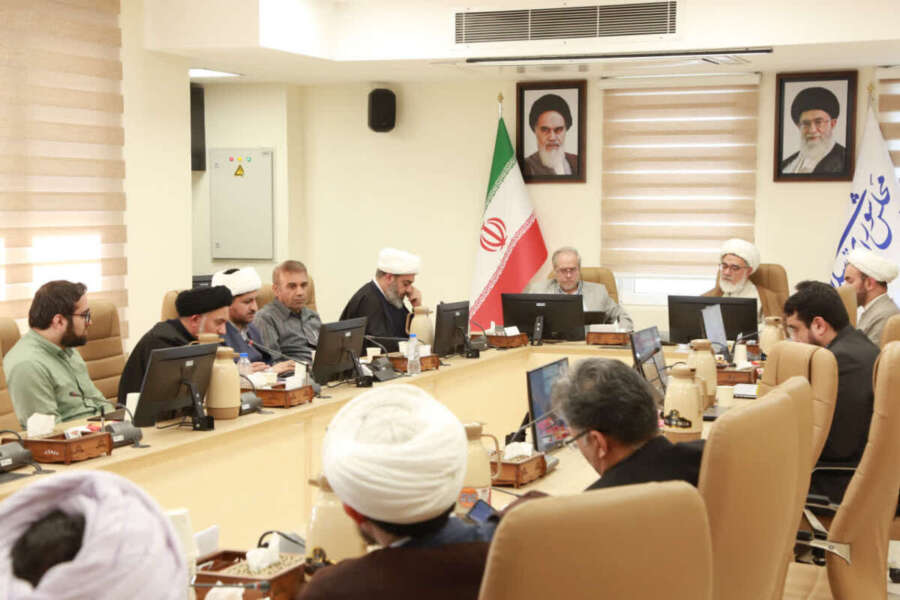
According to the Site of the Institute of Contemporary Jurisprudence Studies, the seventy-third scientific session of “Method on Sundays,” titled “Assessing the Relationship between the Legislative Process and the Obligation to Accept the Law,” was held with the presence of professors and researchers on Wednesday, January 4, 2026, at the Islamic Parliament Research Center.
This session was held as the fourteenth session of the series of sessions on “Methodology of Legislative Governance Based on Islamic Standards” through the efforts of the Institute of Contemporary Jurisprudence Studies, with the support of the “Development and Empowerment of Islamic Sciences” Desk of the Islamic Propagation Office, and the cooperation of the “Jurisprudence and Law Group of the Islamic Parliament Research Center.”
In this session, Hujjat al-Islam wal-Muslimeen Ali Nahavandi, the Head of the Islamic Parliament Research Center, participated as the presenter, and Dr. Mohammad Taqi Dashti, the Deputy of Research at the Islamic Parliament Research Center, participated.
At the beginning, Hujjat al-Islam wal-Muslimeen Dr. Mohammad Reza Gharibi, as the scientific secretary, while stating the importance of the subject and raising this pivotal question—”What measures and capacities must be foreseen in the legislative process of the Islamic Republic of Iran so that the audience of the law is committed to accepting and executing it?”—emphasized that the discussion of the relationship between legislation and the obligation to accept the law is among the relevant and applied issues in the legislative system of the Islamic Republic of Iran.
The expert from the Islamic Parliament Research Center, also referring to the missions of the Islamic Consultative Assembly and the role of the Islamic Parliament Research Center as its content support arm, added: “From the very beginning, it is clear that the raised discussion will be very applied, especially considering the duty that the Parliament has in drafting laws and the necessity of basing laws on Islamic standards.”
Continuing, Hujjat al-Islam wal-Muslimeen Ali Nahavandi, the Head of the Islamic Parliament Research Center, as the presenter, expressed his views regarding the relationship between the legislative process and the obligation to accept the law.
While congratulating the birth of Imam Ali (Peace Be Upon Him), he referred to the importance of the session’s topic and said that the gap between the text of the law and its social acceptance is one of the serious challenges of legal systems.
The Head of the Islamic Parliament Research Center emphasized that religious governance must be able to establish a link between the authority of Sharia and the customary needs of society so that internal adherence to the law is formed.
Reviewing various legal schools of thought, he considered the approach based on Islamic standards to be the only sustainable solution for the internalization of the law and added: “If the legislator cannot establish a precise balance between sovereign authority and the conscientious richness of citizens, the law turns from a national covenant into a soulless directive. It must be noted that in religious governance, explaining the manner of the link between the authority of Sharia and the changing customary needs is an important issue.”
He also emphasized the necessity of transparency in the content of the law and the legislative process, the avoidance of haste in passing laws, and attention to precise needs assessment and impact assessment of laws, stating: “Divine legitimacy and social acceptability must be intertwined to provide the ground for the efficient and effective implementation of laws. Furthermore, transparency in the content of the law and the legislative process is a fundamental condition for an efficient legal system; without it, the law will face confusion and instability.”
In the continuation of the session, Dr. Mohammad Taqi Dashti, as the critic, while appreciating Nahavandi’s presentation, said: “In research we conducted in 2017, dozens of factors for law evasion in Iran were identified, a part of which returns to the legislative process. Sometimes laws are not compatible with existing realities, and this very matter causes people, or even officials, to face problems in their implementation.”
The Deputy of Research at the Islamic Parliament Research Center, referring to legal schools of thought, added: “The obligation to follow the law is achieved in several ways: coercion, persuasion, benefit, and informed agreement. The important point is that the realities of the field cannot be ignored and must be paid attention to in the legislative process.”
Dr. Dashti, in summarizing his view, emphasized that the legal system of Islam is a combination of natural law and positive law, and this interaction can lead to the emergence of a law-abiding state and the strengthening of the rule of law.
In the final part of the session, questions were raised by the attendees. Dr. Saeedi, referring to the pathology of laws, asked: “If a law is not transparent or is passed hastily, is society obliged to submit to it?”
Another participant, raising the view that “a bad law is better than lawlessness,” requested an explanation regarding the position of this approach in the system of the Islamic Republic.
In response, Hujjat al-Islam wal-Muslimeen Nahavandi explained: “There is a difference between legislative Ijtihad and jurisprudential Ijtihad. One cannot say that if a law is contrary to Sharia, people are obliged to execute it. Adherence to the law must correspond with the principle of the preservation of the system, otherwise, it will cause disruption in the system.”
The fourteenth session, by raising diverse views regarding the relationship between the legislative process and the obligation to accept the law, showed that the internalization of the law, transparency, avoidance of haste, and attention to the real needs of society are among the most important requirements of legislative governance in the Islamic Republic of Iran.