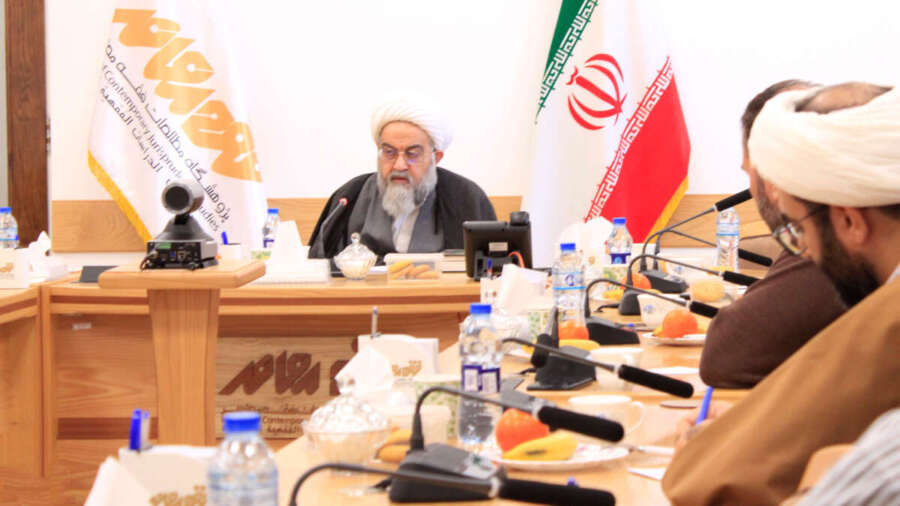
On Sunday, January 11, 2026 (21 Dey 1404), the Research Institute for Contemporary Jurisprudence Studies hosted the 74th installment of its “Method on Sundays” series. Titled “Methodological Imperatives of Transforming Jurisprudential Propositions into Public Culture,” the event was supported by the “Development and Empowerment of Islamic Sciences” desk of the Office of Islamic Propagation and held in collaboration with the Jurisprudence and Law Department of the Islamic Research Center of the Parliament.
Hujjat al-Islam wal-Muslimeen Dr. Mohammad Taqi Sobhani, Head of the “Deepening Religious Faith and Countering Deviant Beliefs” Hub, presented a methodological thesis on the realization of religion within social objectivity through the “System – Paradigm – Program” model.
Opening the session, the scientific secretary, Hujjat al-Islam wal-Muslimeen Mohammad Kazem Haqqani Fazl, Director of the Encyclopedia of Contemporary Jurisprudence, identified the “implementation of religion at the public level” as the primary objective of scholars and the faithful. He argued that transitioning jurisprudential propositions into public culture necessitates a rigorous methodology and a clear conceptual apparatus—elements that, despite their urgency, lack comprehensive scientific formulation.
Dr. Haqqani Fazl distinguished between descriptive and normative propositions in Fiqh, noting that the discourse on public culture centers on normative rulings—commands and prohibitions—pertaining to social, familial, and transactional relations, rather than purely executive or judicial decrees. He also highlighted the relationship between the “Objectives of Sharia” (Maqasid al-Shari’ah) and this cultural transformation as a fundamental area requiring methodical inquiry.
From Theological Cognition to Objective Realization
Dr. Sobhani initiated his presentation with a core inquiry: “How can religious truths and values be actualized in individual lives and social structures?”
He observed that the gap between tradition and modernity has rendered traditional mechanisms of religious realization insufficient. In a fast-paced contemporary world shaped by shifting paradigms, the actualization of religion requires specialized models and processes. Dr. Sobhani described his “System – Paradigm – Program” project as an empirical and natural process for transitioning any ideology from theory to practice.
Phase One: The System – Understanding the Essence of Religion
The first step is identifying “what” religion is—defining its fundamental elements and propositions within an “epistemological system.” This is the realm of cognition (Ma’rifah), where religion is articulated as a set of truths and values. Dr. Sobhani asserted that without a systematic epistemological formulation of religion’s nature, any attempt at objective realization remains groundless.
Phase Two: The Paradigm – The Science of Objective “Hows”
Dr. Sobhani identified this phase as the crux of contemporary challenges. He critiqued the fallacy that “theological understanding automatically leads to social realization.” Instead, he argued that religious manifestation depends on understanding “objective relations.” Distinguishing between “cognition” (Ma’rifah) and “applied science” (Danesh), he noted that while cognition seeks truth, science is an active, intervening force that reconstructs social reality through modeling. Without developing an Islamic science of “hows,” religion cannot become public culture, and secular sciences will continue to obstruct religious values.
Critiquing Minimalism in Religious Theorizing
Dr. Sobhani critiqued existing Islamic intellectual trends, such as the rigid distinction between “School” and “Science” found in the works of Martyr Sadr. He argued that reducing science to mere induction fails to recognize its constructive role in manifesting values. No contemporary legal or economic system can achieve objectivity without producing new structures and institutions.
Phase Three: The Program – Managing Change for Objective Manifestation
The final step is the “Program.” While scientific knowledge of objective relations is vital, it is insufficient on its own. Science is never neutral; it serves the values identified in the “System.” Therefore, scientific formulations are only valid if they fulfill the school’s teleological goals. The realization of any ideology requires “social management and intervention.”
Citing the Sirah of the Prophets, Dr. Sobhani noted that their mission extended beyond teaching; it involved managing the transition from “Ignorance” (Jahiliyyah) to a society of faith. In the modern world, this requires managing social changes via scientific paradigms. In this model, “System” provides recognition, “Paradigm” produces the science of transformation, and “Program” designs the path of objective management.
The Fiqh-Kalam Disjunction and Social Crisis
Dr. Sobhani identified the historical gap between Jurisprudence and Theology as a primary crisis in contemporary scholarship. When Fiqh is detached from theological foundations, it loses its capacity for social realization. Unless Fiqh is reconstructed in alignment with the fundamental goals of religion, it cannot provide a comprehensive framework for modern life. He warned that avoiding “Maqasid-based studies” (Maqasid-shinasi) remains a major hurdle; a jurisprudence that ignores constants, variables, and priorities will inevitably fail in practice.
Critique of Contemporary Approaches to Objectivity
He critiqued two dominant yet flawed approaches:
-
The expansionist view, which assumes that merely increasing the volume of jurisprudential rulings (Ijtihad) ensures religious realization.
-
The reformist view, which alters religious constants to suit temporal requirements.
Both, he argued, alienate religion from social life—one by remaining purely theoretical, the other by surrendering religious frameworks to shifting secular demands. Using economics and banking as examples, he stressed that mere warnings are ineffective; Islamic scholars must produce model-building sciences to offer viable alternatives to dominant global systems.
Conclusion: The Path Forward
Dr. Sobhani concluded that the realization of religion in social life requires the integrated execution of these three steps: systematic cognitive recognition, the production of scientific paradigms for transformation, and purposeful management for objective change.
This session, part of the “Methodology of Legislative Governance” series, has established a new horizon for religious research. It suggests that the transition from a jurisprudential proposition to social behavior is achieved not through mere legislation or preaching, but through the production of applied knowledge centered on objective realities.