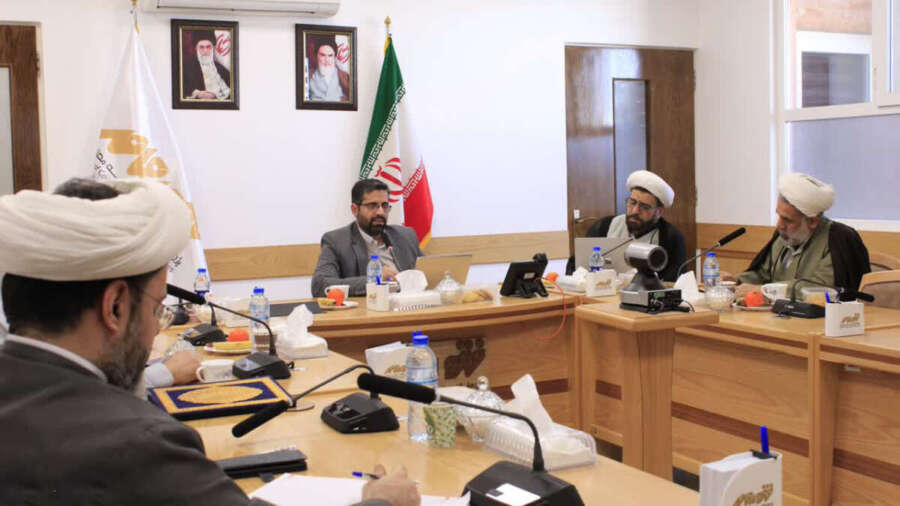
According to the report of the Site of the Research Institute for Contemporary Jurisprudence Studies, the 77th session of “Method on Sundays” was held with the title “The Impact of the Holy Quran on the Method of Producing Islamic Models and Patterns.” This session was organized with the aim of examining the possibility of transcending merely interpretative readings of the Quran and moving toward extracting applied patterns and models for contemporary society and civilization.
In this session, Dr. Mojtaba Rostami-Kia, a researcher in creative industries, through an interdisciplinary presentation, attempted to show that the Holy Quran can, beyond being a source of rulings and doctrinal propositions, be used as a source for producing institutional patterns and models in social, economic, and cultural spheres. Emphasizing an action-oriented view of the Quranic text, he stated: “The Holy Quran is understood not as speech (qawl), but as a representation of action (fi’l),” and this very view facilitates the possibility of extracting practical patterns from the text.
Utilizing cognitive semantics, speech act theory, cultural studies, critical futures studies, and knowledge management simultaneously, Dr. Rostami-Kia presented a five-stage pattern for Quranic modeling. According to him, this process begins with the network analysis of key Quranic concepts, then continues with extracting the cognitive map and conceptual metaphors of the text, and finally reaches the deduction of normative principles, institutional modeling, and social validation. He considered the future of Quranic studies inevitably bound to move toward interdisciplinary approaches and emphasized: “My belief is that the future of Holy Quran studies will be an interdisciplinary future.”
Among the innovative points of this presentation was the use of Large Language Models (LLMs) and artificial intelligence tools for the verification of Quranic conceptual networks; an approach that, according to the presenter, increases the precision of analyzing concepts and semantic relationships of verses and provides the possibility of testability for the extracted models.
In the second part of the session, Hujjat al-Islam wal-Muslimeen Dr. Alireza Qaeminia, a faculty member of the Research Institute for Islamic Culture and Thought, engaged in a scientific critique of this plan. While appreciating the problem-oriented approach of the presentation, he considered it an effort toward reducing the distance between the Quran and society and said: “Islamic studies today have suffered from a kind of abstractionism and have distanced themselves from the objective realities of society.”
Emphasizing the necessity of moving from mere semantics toward the social realization of Quranic teachings, Dr. Qaeminia stated: “Modernizing the understanding of the Quran does not mean imposing new theories upon the Quran; the Quran has new things to say for itself and wants to change human culture and civilization.” At the same time, he considered the use of new knowledge alongside traditional studies a necessary condition for religious civilization-building and noted that mere reliance on classical methods would not be responsive to the complexities of contemporary society.
Despite agreeing with the general idea of Quranic modeling, the faculty member of the Research Institute for Islamic Culture and Thought pointed to some ambiguities in the manner of combining methods and emphasized the pivotal role of cultural studies. According to him, cultural studies should not be employed merely in the final stage, but must have an active presence in the process of extracting patterns and models from the beginning; because the main goal of the Quran is changing culture and organizing the collective life of humans.
In sum, this scientific session showed that the discussion of “Quranic modeling and pattern-designing” has turned into one of the serious and challenging axes of contemporary Islamic studies; an axis that, on one hand, contemplates methodological innovations and the utilization of new sciences, and on the other hand, with fundamental critiques, questions its relationship with social reality, culture, and the possibility of civilizational realization.