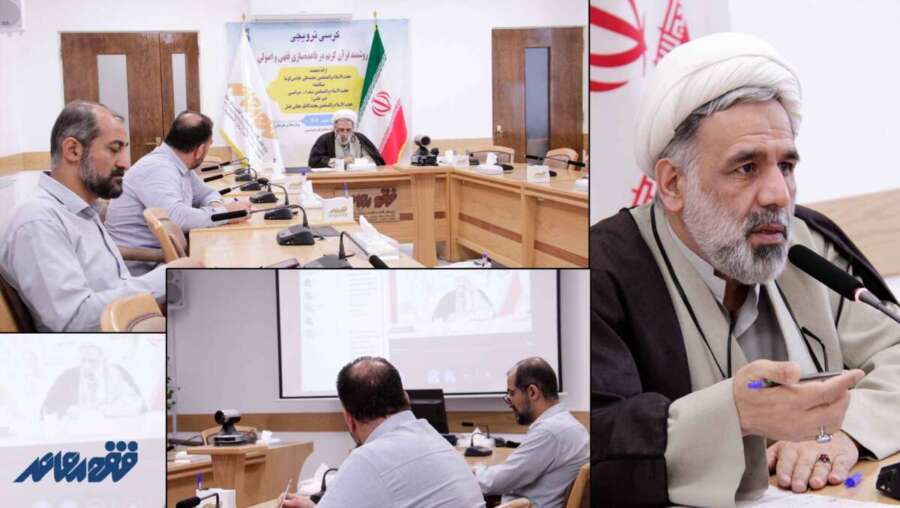
According to the Contemporary Jurisprudence Studies Institute, the eightieth session of the series “Method on Sundays” was held under the title “Qur’an-Based Research Method.”
At the beginning of the session, Hujjat al-Islam wal-Muslimeen Haqqani Fazl, the academic secretary, while referring to the axis of the winter session topic, stated: “Method on Sundays,” which focuses on methodology in contemporary humanities and fiqh, has paid central attention to the point that, despite the differences among various research paradigms (such as empiricism and structuralism), the methodology of Islamic sciences should be directly derived from their primary sources, especially the Qur’an.
Continuing online, Hujjat al-Islam wal-Muslimeen Abdulhamid Wasiti, a faculty member of the Research Institute for Islamic Culture and Thought, as the presenter, explained his view on the “network paradigm” and the possibility of deriving a research method from the Qur’an.
The Qur’an: Source of Knowledge or Source of Method?
Dr. Wasiti began his discussion by posing the question of whether the Qur’an provides anything regarding research method or whether a method for discovering truths is employed in the Qur’an, and proceeded to present his findings.
The faculty member of the Research Institute for Islamic Culture and Thought clarified that what he means by “Qur’an-based research method” is not entering into abstract methodological discussions, but rather searching for tools and techniques of discovering truth within the text of the Qur’an.
In his view, the central axis of this approach is the “network”; a concept formulated in the form of the “network paradigm,” which seeks to analyze phenomena in the interconnection of material, semantic, and structural layers.
Main Argument: The Qur’an Attends to “How”
Dr. Wasiti, to prove the existence of method in the Qur’an, referred to verses containing “kayfa” (how) and said: “Methods are responses to ‘hows,’ and these ‘kayfa’s in the Qur’anic verses fully carry methodological implications; that is, the Qur’an’s attention to method.”
He cited numerous verses, including verse 28 of Surat al-Baqara (“How can you disbelieve in Allah…”) as an example of critiquing a method of thinking, and asserted that the Qur’an questions not only the result but also the process of arriving at the result.
In analyzing verse 260 of Surat al-Baqara (the dialogue of Prophet Abraham, peace be upon him, regarding the revival of the dead), he emphasized that the question pertains to the “how” of realizing a matter, not its principle: “The inquiry of Prophet Abraham is about how, not about the principle of occurrence of revival; and this indicates attention to the stages and process of realizing a reality.”
The Qur’an and the Model of Empirical Discovery
The presenter then attempted to show that even in the realm of empirical discoveries, the Qur’an refers to a kind of methodological logic. Citing the story of Cain in Surat al-Ma’ida, he said: “The killer did not know the method of reaching the result and learned the pattern by observing the action of the crow; this pattern-taking is generalizable and plays the main role in discussions of research method.”
From his perspective, this verse shows that observing a natural process can serve as the basis for discovering a general law or rule; something that is central in empirical research as well.
Hujjat al-Islam wal-Muslimeen Wasiti also referred to the function of the interrogative “kam” (how many/much) in the Qur’an and considered it related to the logic of “accumulation of evidence”; a logic used in empirical research to achieve certainty.
In his belief, reality has intertwined layers, and understanding it requires a network perspective. Dr. Wasiti clarified that this view has been formulated in an independent research titled “Qur’an-Based Paradigm, Network Paradigm” and is currently in the review stages.
He emphasized: If Islamic sciences wish to move beyond the level of approbation (istihsan) and intuitive interpretations, they must present the issue to the Qur’an “without presuppositions” and extract the logic of discovery from the analysis of the verses.
Emphasis on the Methodological Implications of Qur’anic Verses
Hujjat al-Islam wal-Muslimeen Wasiti, continuing his speech and referring to verses such as “So let man observe from what he was created” (Tariq: 5) and “And the heaven He raised and imposed the balance” (al-Rahman: 7), emphasized that the Noble Qur’an, in addition to stating truths, has also attended to the how of the realization of phenomena and, through this, has given importance to the principle of method and the process of discovering reality.
Citing verses such as “Indeed, all things We created with measure” (Qamar: 49) and “And everything with Him is by due measure” (Ra’d: 8), he described the system of existence as a coherent, balanced, and rule-governed network in which every phenomenon has its own specific “measure” and standard, and discovering this measure is the condition for correct encounter with realities.
The faculty member of the Research Institute for Islamic Culture and Thought also referred to the verse “O you who have believed, if there comes to you a disobedient one with information, investigate” (Hujurat: 6), considering data validation as one of the pillars of Qur’anic methodology and evaluating it as directed toward avoiding bias and epistemic error. In his view, verses such as “And you will surely know them by the tone of [their] speech” (Muhammad: 30) also indicate the possibility of discovering inner layers through signs and indications, from which inspirations can be drawn in the field of discourse analysis and semiotics.
Dr. Wasiti, in summarizing the first part of his presentation, asserted that the Noble Qur’an, at various levels—from attention to the origin of phenomena to the analysis of human interiorities as well as the evaluation of social structures—provides the researcher with methodological indications, and based on this evidence, one can speak of a “network research method”; a method that analyzes every reality in the constellation of its connections with God, humans, and other phenomena.
In the continuation of the session, Hujjat al-Islam wal-Muslimeen Alireza Pirouzmand, as the critic (who was also present online in the session), while appreciating the presenter’s efforts, examined the relation of this view to classical methodological discussions and raised questions about the distinction between “method” and “methodology,” the scope of generalizability of Qur’anic examples, and the relation of this approach to prevalent paradigms in the humanities.
He clarified: There has been a confusion between “how” in the sense of explaining a creational or historical reality and “research method” in the sense of the process of problem-solving and moving from the unknown to the known.
According to him, although the Qur’an in numerous instances has addressed the how of creation or social transformations, this exposition does not necessarily mean presenting a research method. He also emphasized that categorizing empiricist, interpretivist, and structuralist paradigms and then extracting Qur’anic evidence for each creates the suspicion that common concepts in research methodology literature have been taken as presuppositions and then applied to the verses.
In the final section, Hujjat al-Islam wal-Muslimeen Wasiti, in response to the criticisms, clarified that what he means by raising “how” is not specific research techniques, but rather the principle of the Qur’an’s attention to the process and path of realization of phenomena. In his belief, the mere presence in the revelatory text of an example of attention to the process of discovery or realization indicates the legitimacy and validity of the principle of method; although determining its rules and scope requires further investigation.
He also stressed that the use of some common methodological terms was merely for approximation to the audience’s mind and not to impose external presuppositions on the Qur’anic text; rather, the goal is to demonstrate the hidden methodological capabilities in the verses to inspire contemporary research.
The session on “Qur’an-Based Research Method” overall sought to open a new horizon in the methodological studies of Islamic sciences. This session can be considered a step toward raising such issues and entering into a methodical dialogue about the relation between the Qur’an and research method; a dialogue that undoubtedly requires the continuation of critique and theoretical completion.