Divine Limits: The Criterion for Assessing the Legitimacy of Laws
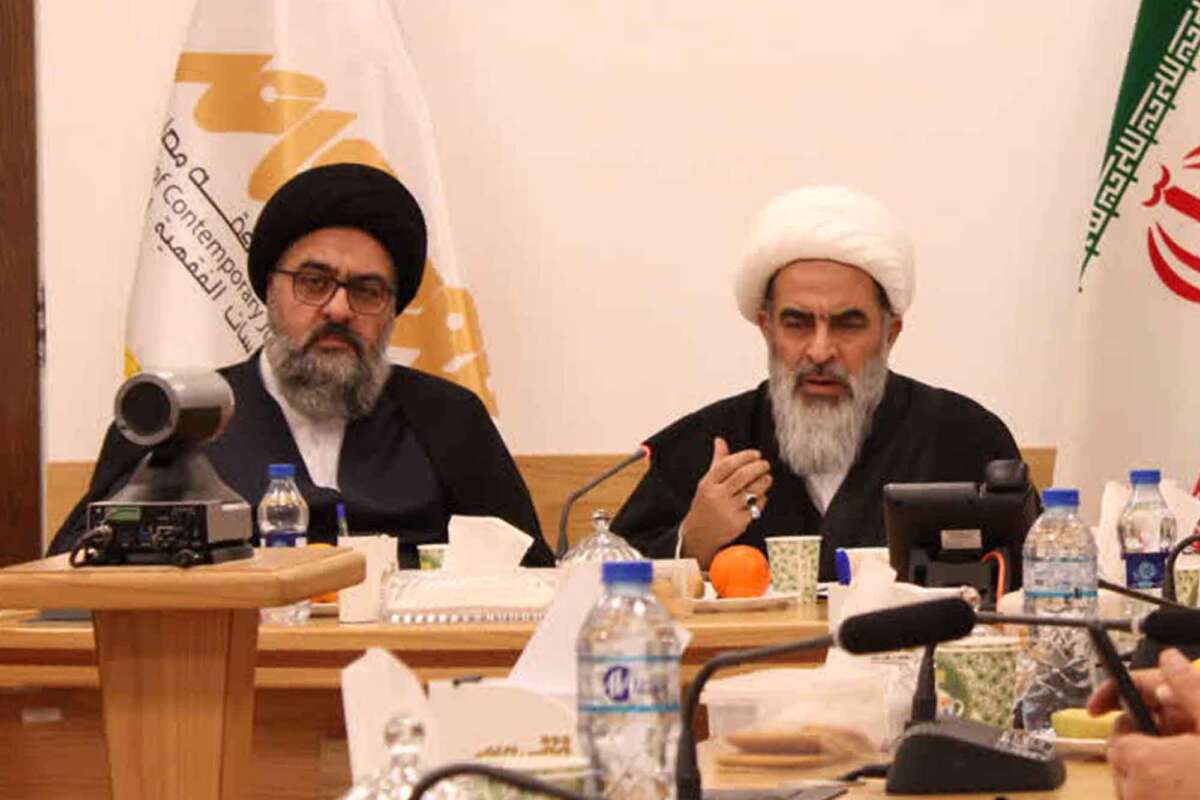
The seventy-first session of the “Method on Sundays” series, entitled “The Process and Methods of Evaluating the Conformity of Law with the Essentials of Jurisprudence and Religion,” took place on Sunday, December 21, 2025, at the Research Institute for Contemporary Jurisprudence. During this session, Ayatollah Mohammad Javad Fazel Lankarani, President of the Jurisprudential Center of the Pure Imams (peace be upon them), served as the principal speaker and expounded upon the Quranic and jurisprudential foundations of the subject.
At the outset of his address, Ayatollah Fazel Lankarani highlighted the significance of the topic, stating: “The question of how laws align with essential rulings—and even non-essential ones—represents a matter of profound importance.”
Drawing upon Quranic verses, he observed: “The Noble Quran frequently employs the phrase ‘limits of Allah,’ as in verse 187 of Surah al-Baqarah: ‘These are the limits of Allah, so do not approach them.'”
The President of the Jurisprudential Center of the Pure Imams (peace be upon them) inferred from these verses: “One jurisprudential principle derivable from the Noble Quran appears to be the obligation to preserve divine rulings. This principle extends to all categories: obligatory acts, prohibitions, recommended acts, and even disapproved ones—all of which must be duly considered within the legislative framework.”
He further emphasized: “Upholding divine limits is incumbent upon everyone—not solely the ruler, but every believer. The Islamic ruler, likewise, bears the duty to formulate laws that precisely align with these divine limits; mere absence of conflict with Sharia does not suffice.”
Ayatollah Fazel Lankarani reiterated: “Upholding divine limits is incumbent upon everyone—not solely the ruler, but every believer. The Islamic ruler, likewise, bears the duty to formulate laws that precisely align with these divine limits; mere absence of conflict with Sharia does not suffice.”
In another segment of his address, he remarked: “That which God has ordained—encompassing the mission of the Prophet (peace be upon him and his progeny), the imamate of the Infallible Imams (peace be upon them), and divine rulings—constitutes divine limits in their entirety. Thus, these limits are not restricted to the Quran alone.”
The President of the Jurisprudential Center of the Pure Imams (peace be upon them) also addressed prevailing challenges, noting: “A key issue pertains to the methodology for discerning the essentials of jurisprudence and religion, as well as reconciling social and international interests with these essentials.”
During the question-and-answer portion, one participant inquired about the interplay between jurisprudential essentials and societal conditions.
In response, Ayatollah Fazel Lankarani clarified: “Jurisprudential essentials admit no deviation, except where secondary rulings or particular social exigencies come into play.”
The President of the Jurisprudential Center of the Pure Imams (peace be upon them), addressing a query on “social and international interests,” stated: “Such interests must be construed within the bounds of preserving divine limits and cannot justify the abeyance of rulings.”
The session concluded with a strong emphasis on the need to revisit the jurisprudential underpinnings of legislation and to clarify criteria for identifying the essentials of jurisprudence and religion. As articulated by the speaker, this criterion must form the central pillar of lawmaking in an Islamic system, wherein social and international interests derive their meaning and legitimacy solely from the preservation of divine limits.