
Faculty Member of the Women and Family Research Institute, in an Exclusive Interview with Contemporary Fiqh:

Examination of the Jurisprudential Dimensions of Spousal Violence/4

Violence against wives has long been a topic in the discourse of women’s jurisprudence and law, with concepts such as spousal rape and the categorization of various forms of violence against women emerging from this dialogue. However, another form of violence, termed violence against husbands, is also conceivable, though it has received less attention in jurisprudential and legal literature. We discussed this issue with Dr. Nahid Salimi, a faculty member of the Women and Family Research Institute. This author and women’s studies scholar believes that violence against husbands has been examined in our jurisprudential literature, but the term itself was coined by societies that permit homosexuality and sexual relationships between men.
The full text of Contemporary Fiqh’s exclusive interview with this faculty member of the Women and Family Research Institute is presented below: 🔻
A Review of Published Books on Cyberspace Governance

Jurisprudence of Governance in Cyberspace/13

Note: Cyberspace governance has been a significant challenge for many countries in recent decades. The importance of this issue has led to the publication of numerous books on the subject.

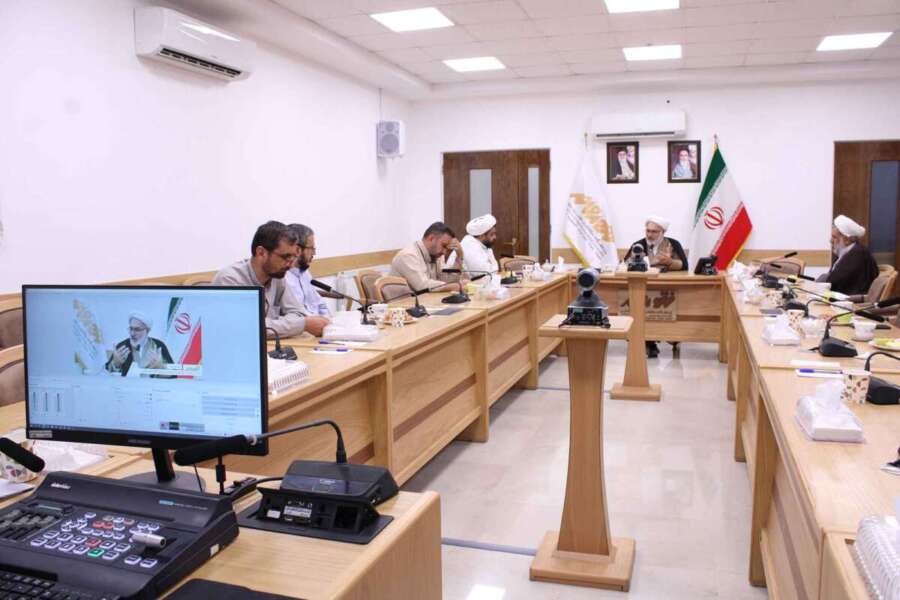
Research Institute for Contemporary Jurisprudence Studies Held

Specialized Session with Hojjat al-Islam wal-Muslimeen Dr. Najaf Lakzaee and Hojjat al-Islam wal-Muslimeen Dr. Reza Gholami, Examining the Role of Religious Governance in Promoting Public Culture and the Necessity of People-Centered Governance

The “Method on Sundays” session, originally scheduled for September 14, was postponed to September 18 due to unforeseen reasons. In this session, the significance of religious governance as a key factor in institutionalizing Islamic knowledge within the public culture of society was examined.
Through in-depth and expert discussions, the session highlighted the importance of people-centered, sound, and Islamic-principled governance in the process of institutionalizing religious knowledge in public culture and emphasized the need to redefine the role of fiqh (Islamic jurisprudence) in addressing society’s strategic issues to tackle complex social challenges.
🏷 View the full text of the news along with the audio of this academic session: 🔻

The Director of the Research Department of Jurisprudence and Law, in an exclusive interview with Contemporary Jurisprudence:

The Right to Human Dignity and Equality from the Perspective of Jurisprudence/4

The issue of dignity and the term “right to dignity” have found their place in jurisprudential discussions in recent decades. The authorship of the book The Principle of Human Dignity as a Jurisprudential Rule was a significant step in theorizing this principle jurisprudentially. Hujjat al-Islam wal-Muslimeen Seyfollah Sarami is among the opponents of the right to dignity. He believes that the term “right to dignity” is fundamentally incorrect, and on the other hand, no divine ruling can be in conflict with the right to dignity. This professor of advanced lessons in jurisprudence and principles at the Qom Seminary, however, considers the conflict of the absolute affirmative application of some rulings with dignity to be unproblematic.
The full text of the candid and exclusive interview of Contemporary Jurisprudence with the Director of the Institute of Jurisprudence and Law at the Research Institute of Islamic Sciences and Culture, on the topic of jurisprudential rulings conflicting with the right to dignity, is as follows: 🔻

Dr. Sadeq Qadimi, in an Exclusive Interview with Contemporary Jurisprudence

Jurisprudence of Governance in Cyberspace/12

Policymaking for cyberspace is one of the significant challenges facing our country, as well as many other countries worldwide. Given Iran’s Islamic identity and reliance on the science of fiqh (Islamic jurisprudence), it is necessary to structure policymaking in a way that aligns or is compatible with jurisprudential rulings. We discussed this topic with Dr. Sadegh Qadimi, who holds a PhD in Fiqh and the Foundations of Islamic Law and is a professor at the Women’s Seminary, with a keen interest in policymaking and cyberspace. His familiarity with both fiqh and the various dimensions of cyberspace policymaking has resulted in an engaging and insightful conversation.
Read the full text of the interview: 🔻

Ali Mohammad Hakimian

Judicial Practical Principles/5

Hojjat al-Islam wal-Muslimeen Dr. Ali Mohammad Hakimian, born in 1960 in Yazd, is a graduate of advanced fiqh and usul (principles of jurisprudence) courses from the Qom Seminary and holds a PhD in private law. Years of teaching various legal disciplines alongside seminary courses have made him one of the most knowledgeable individuals regarding the application of practical principles such as istishab in judicial fiqh. The former head of the Research Institute of Hawza and University believes that many jurists are unaware of the differing functions of fiqh and law, which has led them to err. He also argues that istishab, as a practical principle that does not reveal reality, has no effective role in judicial fiqh. Below is the full text of an exclusive oral commentary by this faculty member of the Research Institute of Hawza and University for contemporary fiqh: 🔻

Morteza Torabi

Judicial Practical Principles/4

The 26th session of the International Islamic Fiqh Academy was held from May 7–11, 2025, in Doha, Qatar. A delegation of scholars and professors from Iran, led by Ayatollah Moghbali, participated in this event. One of the presenters from the Iranian delegation was Professor Morteza Torabi, who presented a paper titled “Istishab and Its Concept, Types, Relationship with Other Sources of Legislation, Its Evidentiary Value, and Its Applications in Emerging and Novel Issues.” Below is the author’s report on this paper, which offers new applications to contemporary jurisprudence, including judicial and criminal law.

A Look at the National Center for Cyberspace:

Jurisprudence of Governance in Cyberspace/11

The National Center for Cyberspace was established in 2011 by the decree of the Supreme Leader with the purpose of providing governance and regulation for the country’s cyberspace. Below is a report on the missions and activities carried out by this center. 🔻

President of the Faculty of Religion and Media, in an Exclusive Interview with Contemporary Jurisprudence:

Jurisprudence of Governance in Cyberspace/10

Cyberspace is no longer merely a possibility but has emerged as a second realm of human life, occupying a significant portion of people’s lives. Dr. Kamal Akbari, born in 1975 in Qazvin, has been engaged in research and study of cyberspace for years, both out of personal interest and as part of his responsibilities as the President of the Faculty of Religion and Media.
🔹This associate professor at the Islamic Republic of Iran Broadcasting University, who has pursued advanced seminary studies in jurisprudence and principles of jurisprudence and holds a post-doctorate in political communication, believes that to establish the jurisprudential branch of cyberspace jurisprudence, a specialized principles of jurisprudence for this field must be developed. He also considers that jurisprudential rules need revision and adaptation to address cyberspace jurisprudence.
The full text of the exclusive interview by Contemporary Jurisprudence with the President of the Faculty of Religion and Media follows: 🔻

Secretary of the Environmental Working Group at the Islamic Research Center of the Parliament, in an Exclusive Interview with Contemporary Jurisprudence:

Governance in the Preservation and Protection of Natural Resources from the Perspective of Imami Jurisprudence/3

One of the criticisms leveled against the discipline of jurisprudence is that jurists have not issued clear and explicit fatwas to support natural resources, which has led to the gradual destruction of these resources in Islamic countries. However, Hujjat al-Islam Salman Behjat Ardakani holds a contrary view.
🔹This author and researcher of environmental jurisprudence believes that jurisprudence, its scholarly heritage, and its sources possess an extraordinary capacity to support environmental protection. As a member of the Environmental Steering Committee of the Seminaries and an expert at the Environmental Jurisprudence Research Desk at the Institute of Advanced Jurisprudence and Islamic Sciences, he highlights several examples of the capacity of jurisprudence to support the environment and natural resources in this exclusive interview.
The full text of the exclusive interview by Contemporary Jurisprudence with the Secretary of the Environmental, Water, Natural Resources, and Agriculture Working Group at the Islamic Research Center of the Parliament follows: 🔻